The Insect Stampede of Salsa Invertebraxa

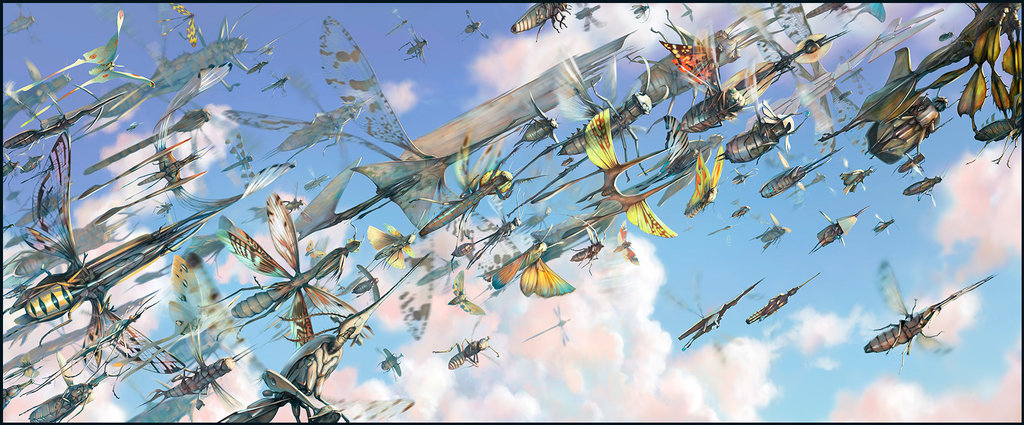
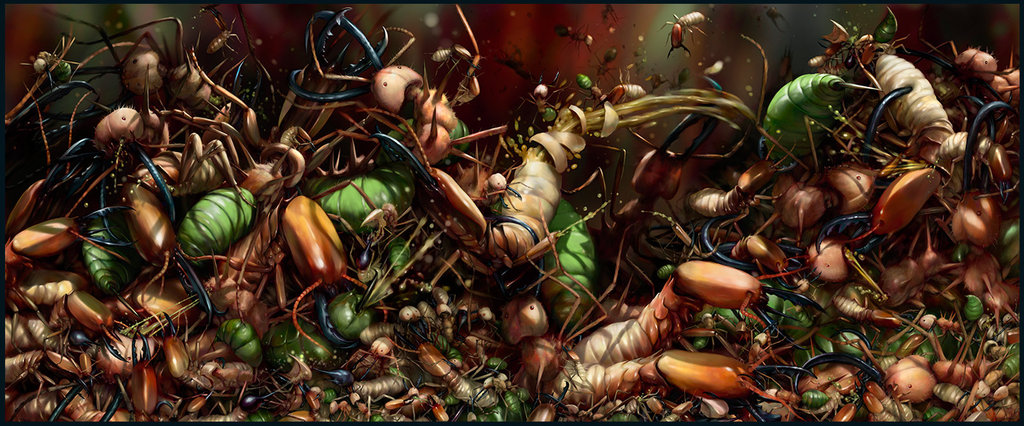
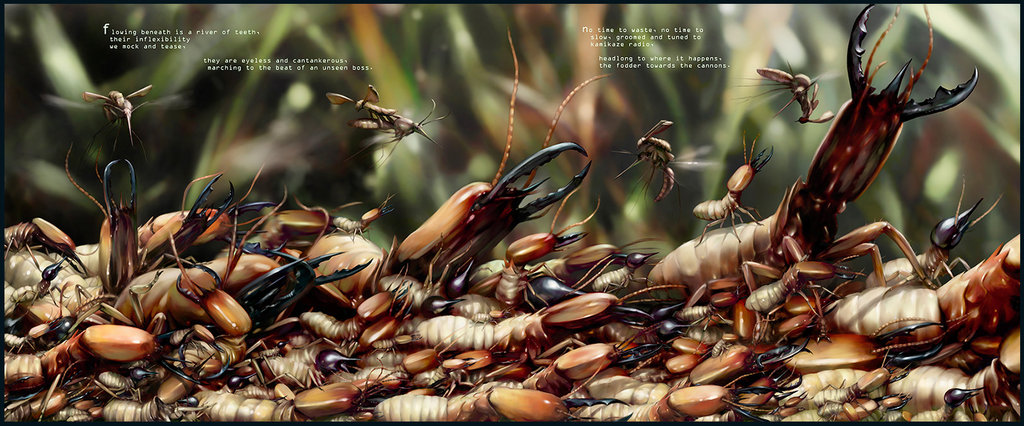
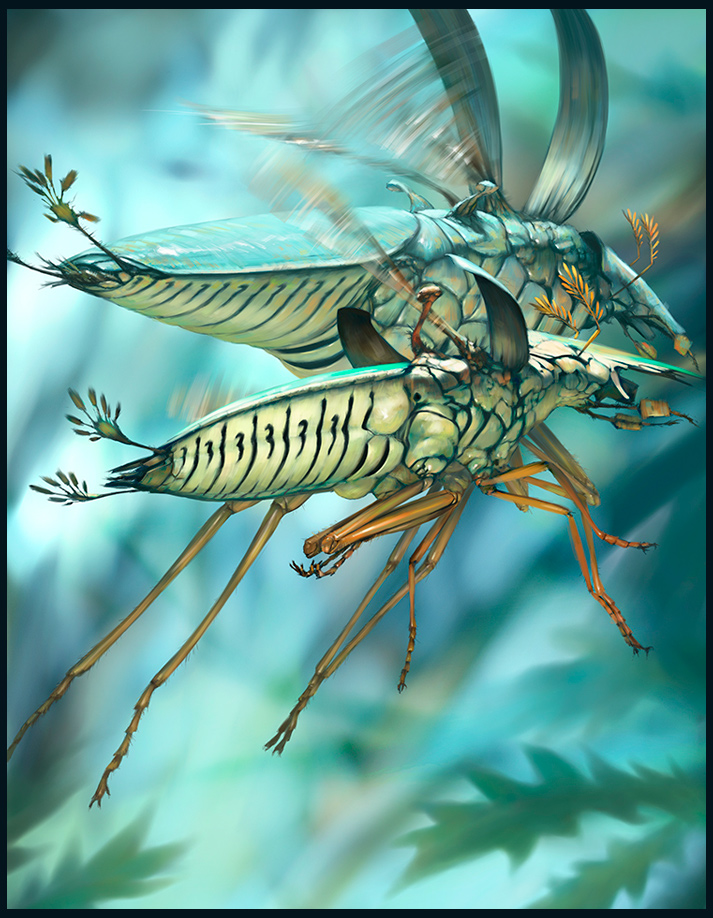
Add this to the list of bug books I would love to paw through: Mozchops is a concept artist and illustrator who has taken his talents into the realm of graphic novels, and crafted a story around his epic insect artworks. Phippen has created a riot of invertebrate morphology that dances around the real and plausible and quickly plummets into masses of invented forms and characters called Salsa Invertebraxa. Just check out these lovely works!

salsa_invertebraxa__swarm

salsa_invertebraxa___war

salsa_invertebraxa__melee

salsa_invertebraxa__flight

l love the colossal scale he gives his insects- your POV is truly that of a microscopic denizen.   I have a weakness for a good micropublished concept art book, and one filled with incredible insects and a storyline sounds like a blast. His book is available in a few stores in the UK, but you can order it here. z end

Posted in art, literature | Tagged , , | Leave a comment

Cyriak’s Spiders

Cyriak is a freelance animator known for turning cows and cats and sheep into bizarre spiderbeast creations. But in Cobwebs, made for Showtime, it’s spiders all the way up, down, and sideways. z end


Posted in film, lol | Tagged , , | Leave a comment

Your Path Made Manifest

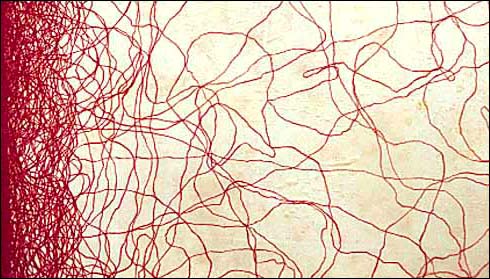
Ant trails. Depending how you look at them, they’re tiny living rivers, unending highways of industry, pseudopods of super-organsisms, or just a bunch of half-brained haplodiploid hymenopterans with a fetish for each other’s footprints. They are viewed as a product of sophisticated determination, and simultaneously one of  mindless chance, but in everyone they stir a powerful notions of combined effort and destiny.

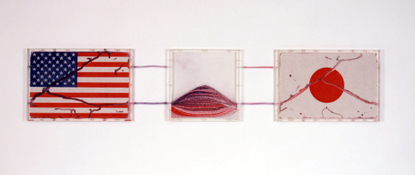
yanagi_flags

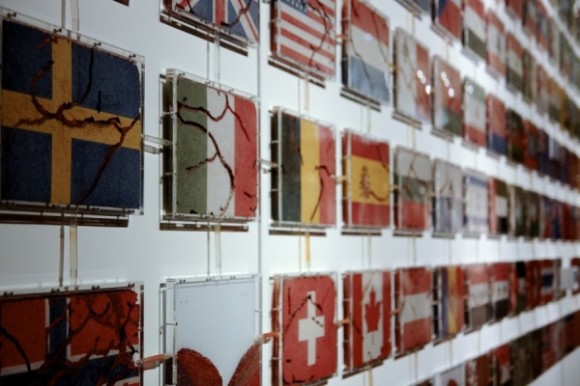
Yukinori Yanagi, The World Flag Ant Farm, 1990

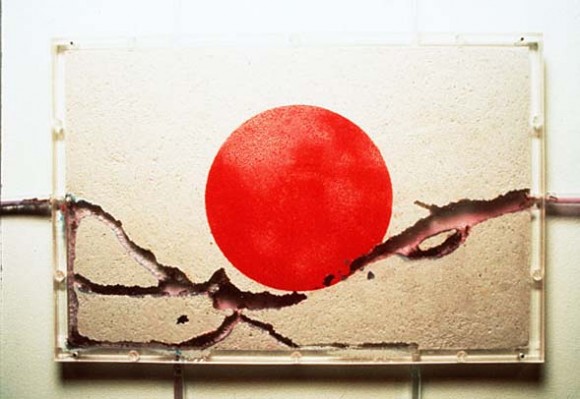
In the late 80′s, Yukinori Yanagi began working with ants, creating boxes filled with colored sand to mimic flags of various nations. Into these he would release live ants, who dug into them (like classic ant farms), producing fractures, and even exchanging sand between flags via tubes.

yanagi_flags2

Yukinori Yanagi, Pacific, 1997

yanagi_flags3

Yukinori Yanagi, Pacific, (detail) 1997

The stalwart ants dilligently burrow into potent symbols of nationalism, while at the same time are completely oblivious of the artificial borders and barricades those symbols hope to convey. I would have loved to have seen these works in person.

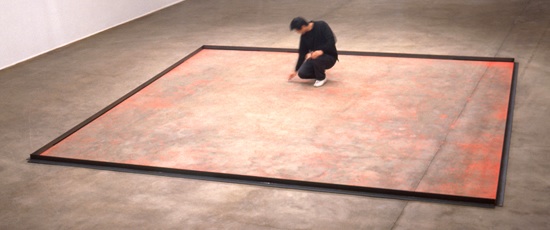
yanagi

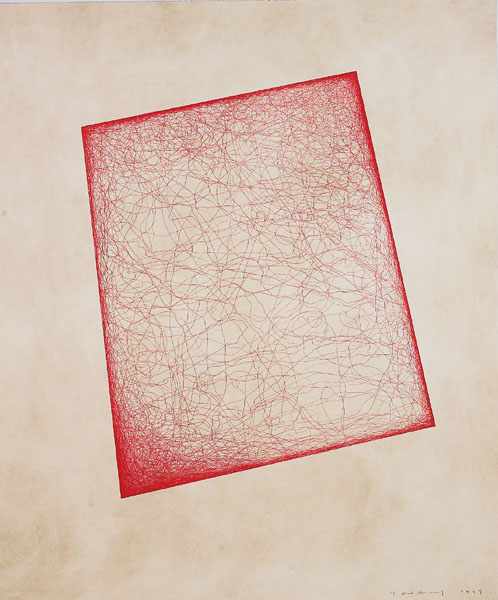
Yukinori Yanagi, Wandering Position, 1998

But it’s his Wandering Position series that most captivates me. A single solitary ant is let loose in a large rectangular enclosure. Following it with a wax crayon, Yanagi illuminates the lonely life of a tiny lost soul, penned in by unseen forces, yet never giving up. They’re powerful pieces, especially when done in the context of incarceration, such as his installation at Alcatraz in 1996.

yanagi_london

Yukinori Yanagi, Wandering Position, 1997

yanagi2

Yukinori Yanagi, Wandering Position, 1997

Mostly I find myself wondering what kind of ant it was. Not sure why that matters to me, but I do think different species of ants would have produced vastly different trail-based artworks.

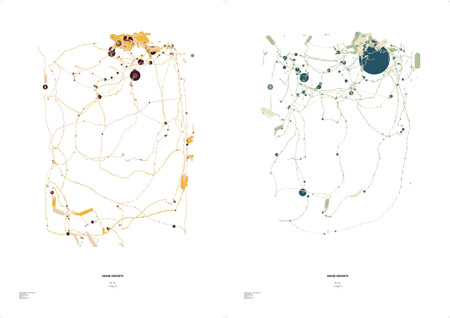
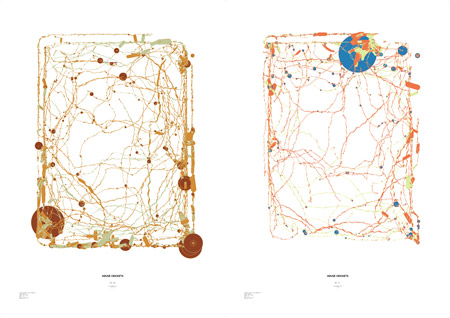
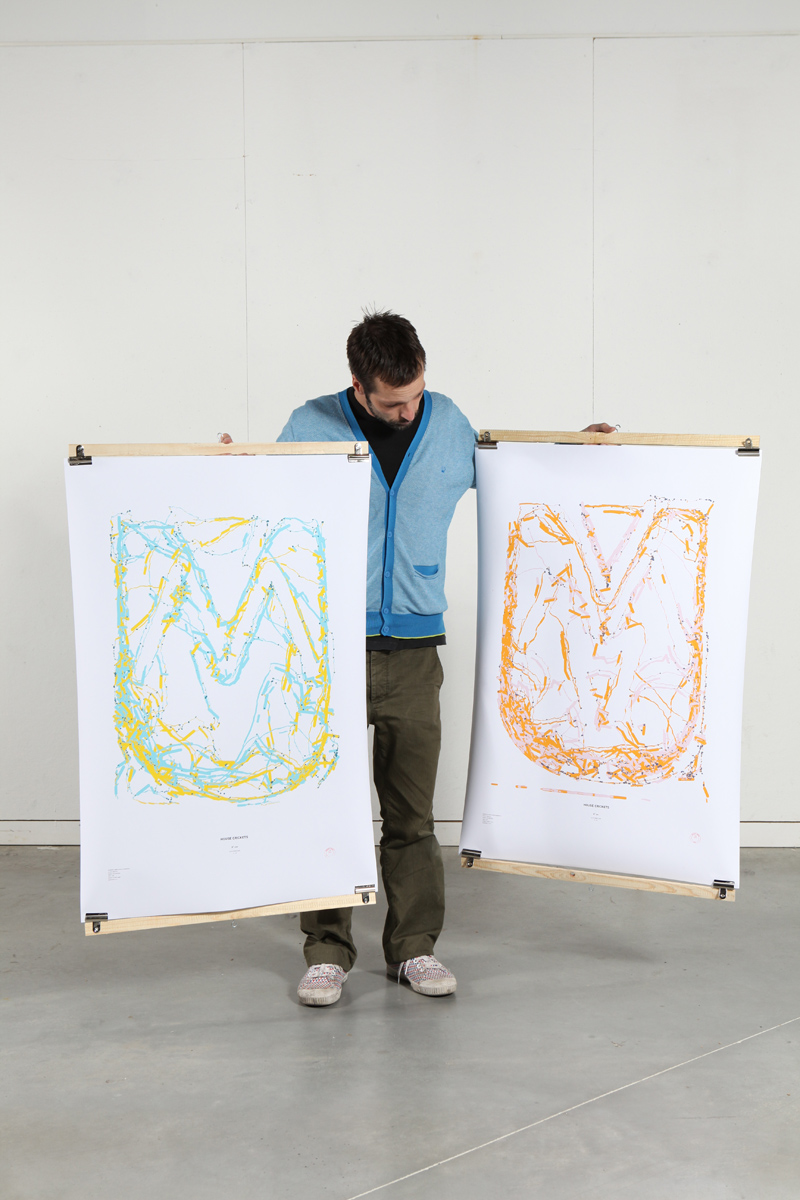
Which brings me to perhaps a more whimsical use of the meanderings of ants (and other insects). Dutch design firm Edhv used a webcam hooked up to open source C++ script that records the movements of individual insects, assigning various colors to directions. Objects placed in the insect’s paths helped direct movement, but mostly it was up to the organism itself. Different species of insects created different patterns using the same obstacle course. Once a certain distance was reached, the work was declared finished, and a poster printed depicting their movements.

The final results (mostly used with woodlice and house crickets) are beautiful works countering the living force of the insects with utopian synthetic designwork. The insects clamber between logos, spelling out their own world between the lines of humanity.

nyc_debug_02 nyc_debug_04

edhv_debugged3

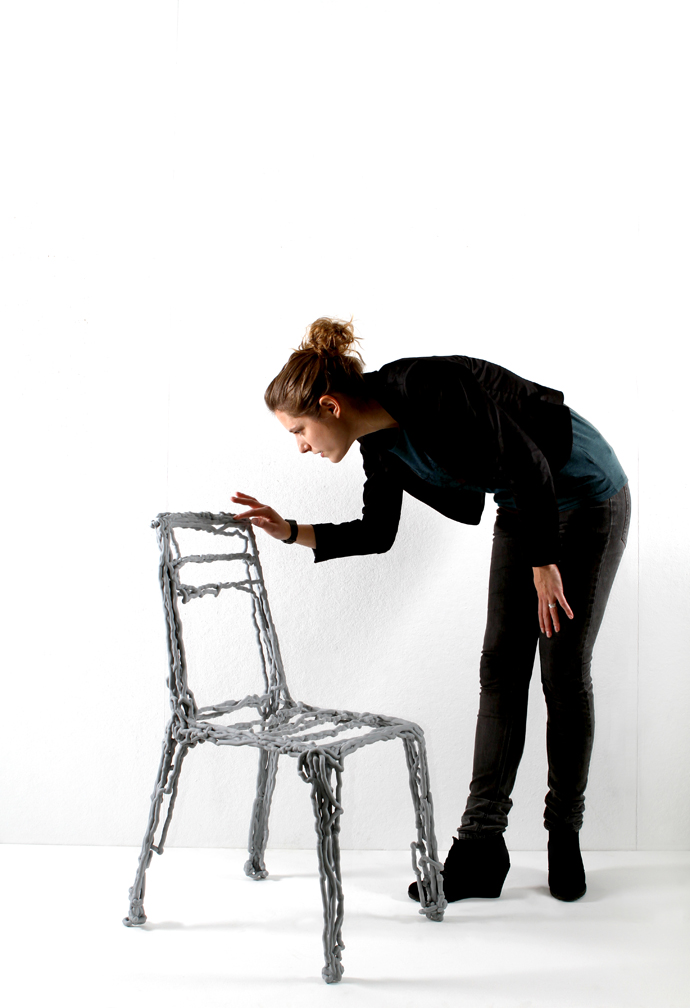
The next year Edhv went one dimension better, turning a solitary ant (again, what kind? can anyone tell?) loose on a tiny model of a chair. The ant’s movements were recorded as a computer model, which was then 3D-printed to create the ‘Debug Chair‘, a physical manifestation of one ant’s journey through the perplexing world of human design.

Debug_Chair_by_Edhv_web

Debug Chair by Edhv and an uncredited ant.

Neat! Perhaps for their next creation they can make an Eciton bivouac sofa. z end


Posted in art | Tagged , , , , , | Leave a comment

Wonderful First Life

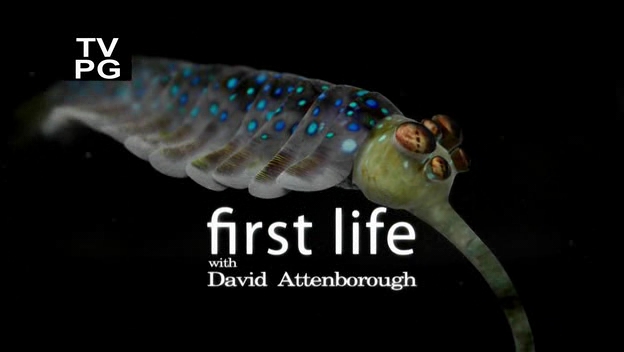
The only thing more swooneriffic than David Attenborough narrating a nature documentary is one where he’s narrating a nature documentary about invertebrates. And the only thing even more thrilling than that is when he’s talking about Extremely Obscure Invertebrates, such as those which were last seen over 400 million years ago.

attenborough_opabinia

Opabinia! With blue spots and red eyes because why the hell not!

First Life was produced two years ago, but managed to sneak under my Sir David Radar until last night. It’s a small 2-segment documentary that nonetheless manages to follow the unstoppable Attenborough as he visits tropical forests in Queensland, windswept Scottish shores, and finally the fabled Burgess Shale hidden among the lofty mountains of the Canadian Rockies.  All of this to tell the story of how early animal life began to diversify on our planet.

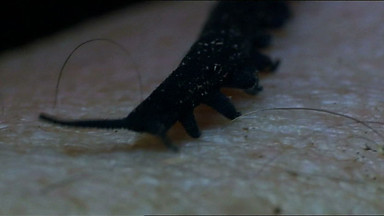
Along the way we visit some of our planet’s invertebrates who are living links to the deep time of Earth’s past. One of the wonderful segments involves the onychophoran, an eyeless multilegged predator also known as the velvet worm. I could watch it dumpling about on its clawed legs all day.

attenborough_velvetworm

I admit it. I’m jealous that this lucky bastard got to walk on Attenborough’s arm.

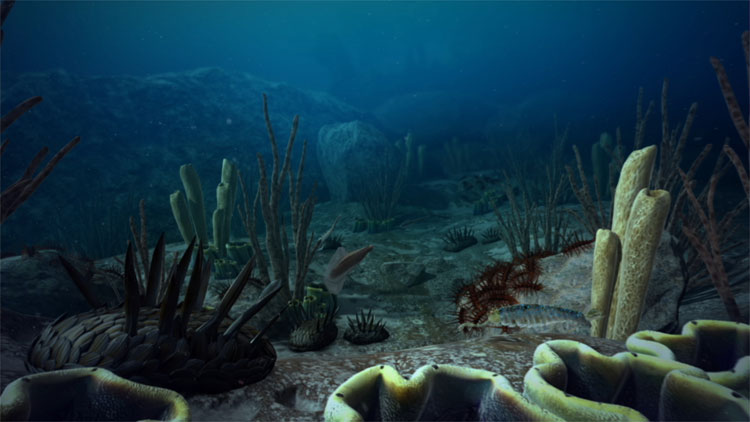
First Life swings through the Ediacarian to bring us through the Cambrian, and it’s here where the  CGI really takes hold. The digital care taken to animate such paleontological celebrities such as Opabinia and Anomalocaris is a joy to watch, especially for a fanboy like me who has read Gould’s  Wonderful Life at least 3 times, back in the day. Even bizarre little Hallucigenia is brought to life, and this time in a more plausible position!

Attenborough_cambrian

Extreme Cambrian CGI Explosion

To explain how absolutely badass Anomalocaris must have been in the Cambrian reefs, Attenborough pisses the hell out of one of the toughest arthropods alive today, a mantis shrimp. These strikingly sculpted stomatopods can see better and move faster than we can. They are therefore handled with extreme care lest they slice us to ribbons, smash out our windows, and redecorate our rooms with lurid colors that appeal to their enhanced eyesight.

Attenborough about to get his finger sliced off

Oh David, those gloves won’t protect you at all.

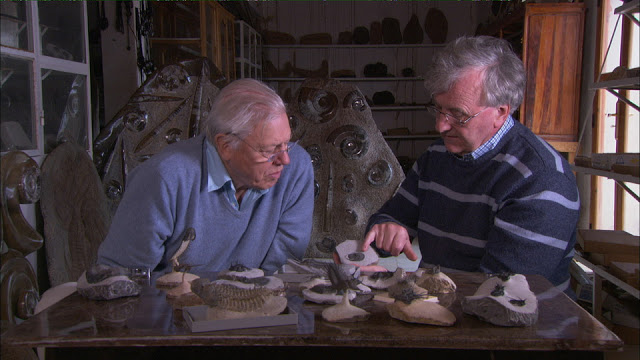
One of the satisfying things about First Life is the array of scientists who get to share some camera time, and talk about the obscure organisms to which they’ve dedicated their lives. How often does a specialist in bacterial extremophiles get to be on the BBC? And when it came time to talk about trilobites, it was great to see Richard Fortey dispense oodles of paleo-factoids right out of his book Trilobites: Eyewitness to Evolution, as the camera spins around an endless supply of masterfully prepared fossil specimens that are way out of your price range.

Tonight on Paleo-Antiques Roadshow: We sort the fakes from the Phacops

“Tonight on Paleo-Antiques Roadshow: We sort the fakes from the Phacops!”

Of course, the DVD that’s for sale on Amazon or whatever is Region 2 which means unavailable in the US, because reasons of stupid. So until you can get your palps on a copy of First Life, you’ll have to hop on the internets, and get scouring. Here’s a couple of links that hopefully won’t get the axe anytime soon.

Watch’em before they disappear like Meganeura!z end

Posted in film | Tagged , , , , | Leave a comment

Stridulation Friday presents: Insect Poetry


This charming stop-motion film was created by members of Will Vinton Studios during a haitus in the Summer of 2000. Directed by Marilyn Zornado, it features the poetry of the late Meme Marie Meyers. I especially love the fun use of calligraphy throughout. Long live the Insect Literary Society!

Posted in film, literature | Tagged , , , | Leave a comment

The Insect Art of Claire Moynihan

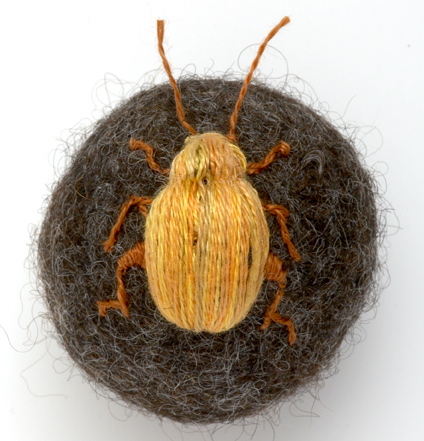
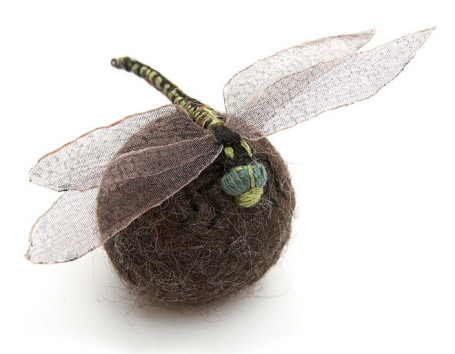
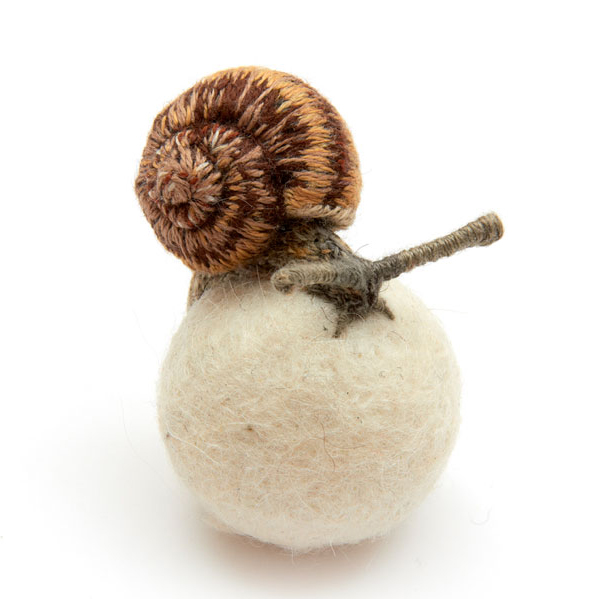
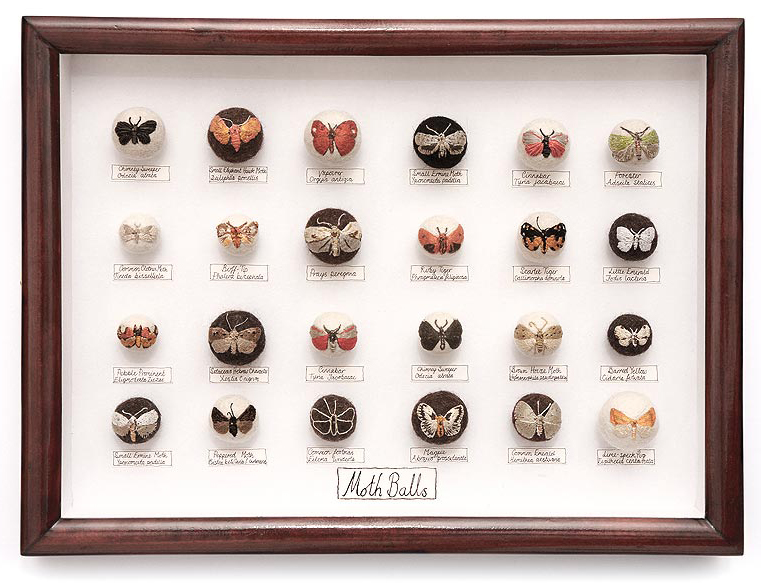
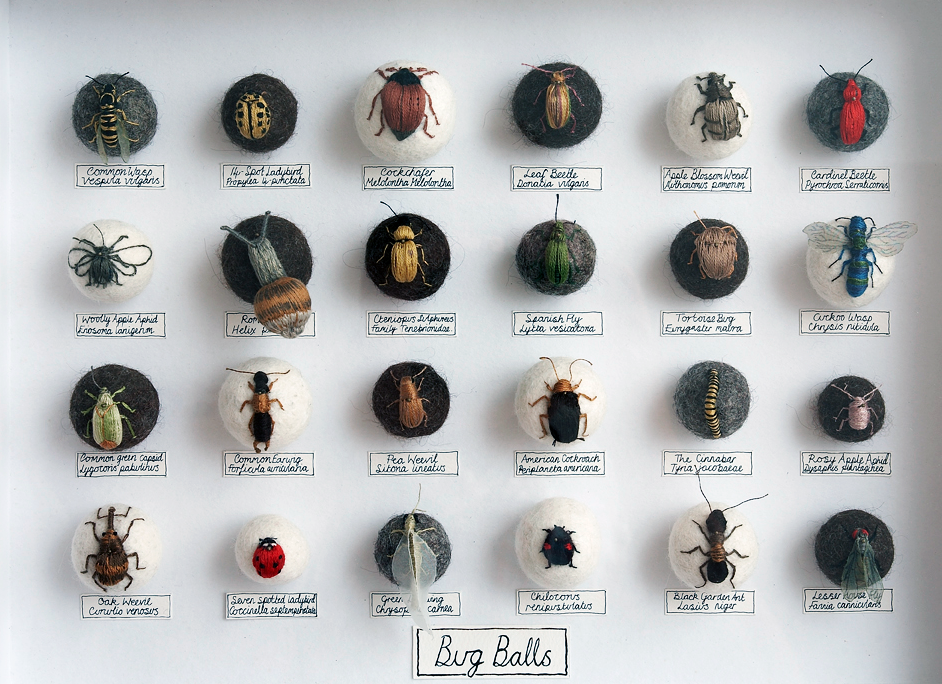
Claire Moynihan hand-embroiders intricate British insects and invertebrates on to small spheres of alpaca felt. The individual works are impressive, dimensional and vibrant- the creatures look as if they’ve just alighted there for the moment, ready to take off.

moynihan-hornetball

moynihan-fleabeetle

moynihan-southern-hawker

moynihan-gardenSnail

moynihan-mothballsI

moynihan-bugballs

Collected like scientific specimens, her “bug balls” are displayed in large shadow boxes, along with their scientific names. Her gallery of collections must be seen to appreciate the amount of intricate work that goes into each insect. Though Moynihan started with moths (making moth balls, of course!) her menagerie spread to all sorts of British insects, including many thought of as pests, such as aphids and earwigs. Her celebration of unloved inverts seems to be the focus of her work, calling attention to the minute mouths which feed on cabbage, cottage, and couture with indifferent ease. z end

Posted in art | Tagged | Leave a comment

And the Guldbaggen goes to…

Okay now everybody show us your beetle

Every January, the Swedish Film Institute deliberates over its list of nominations, and in a televised ceremony proudly announces its winners. But instead of being handed some polished ideal of an abstract humanoid figure, they are given a craggy lump of enameled copper that has been hammered by hand into the shape of a rather somewhat crude beetle. It is loud, lumpy, nearly unrecognizable, and it’s the highest honor the Swedish Film Institute can bestow upon their native artisans. It’s the Guldbagge Award, and I can’t help but think that it’s the coolest film award ever made.

guldbaggen_award

The award was designed by Swedish artist Karl Max Pehrson (1921-2005) , a native painter of biomorphic phantasmagoria whose alien plants and lush impossible landscapes rival the Codex Seraphinianus for sheer weirdness. While his paintings won admiration for their fanciful details, his lumpy brutish sculptures were another story. In 1954 a solo show of his work of his sculptures earned some notoriety because critics were turned off by his ‘offensive’ creations.  Rough and abstract, his subjects weren’t plants, but another organism dear to his heart: Beetles.

Pehrson's studio, filled with beetles real and imagined.

Pehrson’s studio, filled with beetles real and imagined.

Karl Axel Pehrson, Brown Stone Beetle, 1960

Karl Axel Pehrson, Brown Stone Beetle, 1960

Karl Axel Pehrson, Iameridotta, 1964

Karl Axel Pehrson, Iameridotta, 1964

Pehrson seemed to have created an uncountable number of beetle sculptures, in glass and wire, stone and clay. Even though they’re clearly insects from another world, his years of intense insect-collecting shines through each sculpture. You can nearly see the real coleopterans he used for inspiration, hovering around each sculpture like a ghost image. In fact the Guldbaggen award that Pehrson designed for the SFI is modeled after a specific beetle, Cetonia aurata, the green rose chafer, that it is common during the Summer months in Sweden.

If you visit Stockholm and take the metro, you’re in for a treat; Inside Gärdet station there are several public displays of Pehrson’s beetles, each with made-up Latin names (that you can even barely read in some of Olsson’s photos below) Sadly, since the installation of  “Animals That Don’t Exist” in the late 60′s, some of the beetles have been stolen, and only photographs of those originals remain. No matter what condition, I’d love to view these in person some day.

Karl Axel Pehrson, Section of "Animals that don't exist", 1964. Photo by Marit Furn

Karl Axel Pehrson, Section of “Animals That Don’t Exist”, 1967. Photo by Marit Furn

Karl Axel Pehrson, "Animals That Don't Exist", 1964. Photo by Lars Olsson

Karl Axel Pehrson, “Animals That Don’t Exist”, 1967. Photo by Lars Olsson

Karl Axel Pehrson, "Animals That Don't Exist", 1964. Photo by Lars Olsson

Karl Axel Pehrson, “Animals That Don’t Exist”, 1967. Photo by Lars Olsson

Karl Axel Pehrson, "Animals That Don't Exist", 1964. Photo by Lars Olsson

Karl Axel Pehrson, “Animals That Don’t Exist”, 1967. Photo by Lars Olsson

Karl Axel Pehrson, "Animals That Don't Exist", 1964. Photo by Lars Olsson

Karl Axel Pehrson, “Animals That Don’t Exist”, 1967. Photo by Lars Olsson

Even though Pehrson passed away in 2005, his legendary Guldbaggen is still being created, up to 18 a year. Each Guldbaggen is a work of art made by hand, hammered and welded out of copper, then enameled and gilded. Over 300 of these beetles have been awarded since the award’s inception in 1964. And it looks like Sweden has come to really love their strange award. Filmmakers and celebrities gratefully hold up their blocky beetles each year, beaming at the cameras. And then there’s this:

2003 Guldbaggen Awards performance

Thank you, Sweden.

The above performance was for the 2003 Guldbagge Awards. You can bet I’ll be watching this January 27th to see what they do this year! z end

Posted in art, film | Tagged , , , | Leave a comment

The Insect Art of John Dilnot

dilnot_underfoot

The above work is “Underfoot”, a limited edition screen print by Brighton-based artist John Dilnot. His works are a giddy riot of form and color, whether they’re folded into chaotic garden scenes or cut out and crowded into wooden boxes. Though birds and bad apples are also part of his reportoire, his studio churns out wonderful arrays of moths, beetles, and caterpillars, ready to jump off the watercolor paper even as they sit in ordered rows. Go check out the fun on his website . Here’s just a sample of his entomological printworks.

dilnot_caterpillars

dilnot_beetles

dilnot_pests

John Dilnot moth collection

And last but not least one of his rich art boxes, “Moth Collection”, 2012.  It looks like a vintage children’s book suddenly sublimated into lepidopterans. z end


Posted in art | Tagged , , , , | Leave a comment

Stridulation Friday: Infime

infime from Cut And Cook Studio. Can’t get enough of the fantasy macro action! For those with fat bandwidth, see it in fullscreen. z end

Posted in film | Tagged , | Leave a comment

The Insect Art of Ergin İnan

A Thanksgiving trip to Istanbul found me at the Istanbul Museum of Modern Art on a rainy week-day, enjoying an enthralling collection of contemporary artworks. Along with  an absolutely top-notch Design Biennial, the museum had on display a sweeping retrospective of Turkish artwork, nearly all of it unknown to this westerner’s eye. Photography was forbidden in the museum, but for one picture I couldn’t help myself, and you can see why.

Ergin İnan, self portrait

Ergin İnan, Self Portrait, 1996. I was totally not allowed to take this picture.

And now I’m glad I did, because Ergin İnan is one majorly prolific insect-obsessed artist. Unfortunately there is little online about İnan in English, and the esoteric discussions in Turkish about his art practice are hopelessly garbled by services like Google Translate. Something about a childhood letter that he drew insects on? A contemplation of transformation of the spirit and mind? I’m left to my own devices on his symbolism, but that won’t stop me from enjoying his paintings.

In İnan’s works, insects seem to hold the key to the gateway to magical worlds beyond, full of incantations, prayers, and poetry. The care and reality in which he renders his invertebrate subjects is often at a deep contrast to his vertebrate ones. His human portraits are ghostly gossamer shades, just as translucent as the prodigious dragonfly wings that sprout from their backs amidst clouds of arabic text. Or else they look like technicolor Bacon-esque smears, their souls made visible only in the form of a resplendent scarab beetle.

I hope to showcase more of İnan’s art in the future, and possibly track down some coherent criticism regarding his themes and feelings towards his favorite subject. But for right now I am just thrilled that a sneaky snapshot in a museum led me to one of Turkey’s foremost insect artists. Güzel! z end

Posted in art | Tagged , , , | 4 Comments