“An October Spirit Embiggens The Smallest Insect”

October is a great time for the staff here at the Endless Swarm. It’s the one time the rest of the world seems to pay attention to the world of the unloved invertebrate. Entomological festivals get scheduled, museums dust off their insect zoos, and every creeping crawly swells and mutates to the size of city blocks.  Well, in movies and fiction at least. To kick off a grand tour of this month’s Brobdingnagian bugdom, we go back to the start of last century:

“In the following article the insects and scenes represented are from actual photographs”

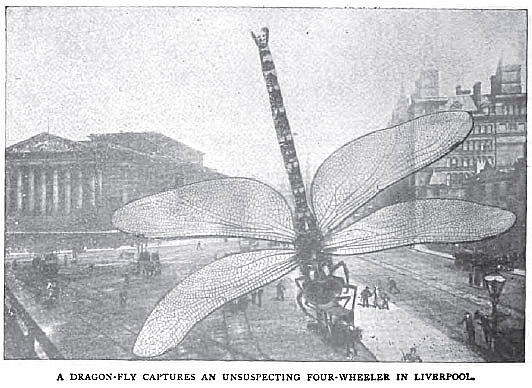
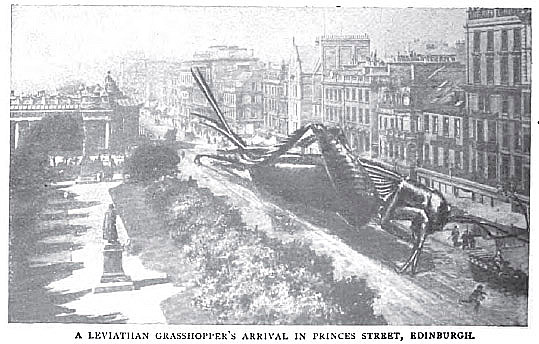
In 1910 The Strand magazine published an amusing article about giant insects. Though the chaps at Futility Closet were kind enough to post the images for all the world to LOL at, I wanted to read the rest of this essay. Anything that doesn’t have a source makes me a bit hoax-suspicious, so naturally I wanted to hunt down the original article. Thankfully the full article is here in PDF form, and contains all manner of delightful forays into the chaos that would ensue from giant invertebrates running amok! I would love to share with you some of the choicer paragraphs (as well as the original images) below.

w

e are, are (save a few contented ones) so apt to be perpetually complaining of the disadvantages and drawbacks of life that we hardly even stop to realize how much more severe and discouraging mundane conditions might be. Suppose the temperature of a really hot day were two hundred degrees Fahrenheit in the shade, instead of a paltry eighty-five or ninety! Or one hundred below zero on a wintry one! Then we might really complain if hailstones were of the size and shape of cannon-balls, and it hailed twice a week.”
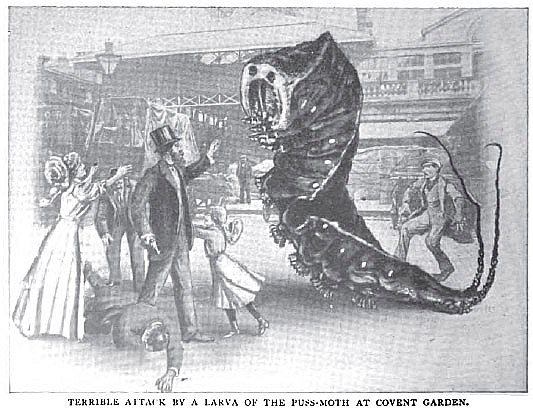
puss-moth caterpillar, Strand Magazine, 1910

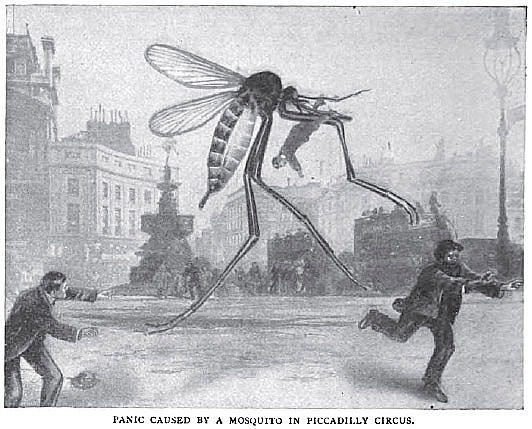
“Or take our insect pests. What a terrible calamity, what a stupefying circumstance, if mosquitoes were the size of camels, and a herd of wild slugs the size of elephants invaded our gardens and had to be shot with rifles, unless Maxim guns were to be employed for the purpose!  Truly, in these respects we are a lucky race, living under almost ideal conditions.

It is true we are still molested by hordes of wild animals of bloodthirsty propensities. These wild animals only lack the single quality—namely, that of size—to render them all – powerful and all – desolating, and this quality they have not been able to attain owing to the lack of favouring conditions.

How easily it might be otherwise. Suppose, for example, that a few yards from the office of this Magazine, in Covent Garden Market, a terrible Fuss – moth larva were to have escaped from his cage or his keeper—if, indeed, he were not to have developed into gigantic proportions in a single night—what a panic would be caused!”
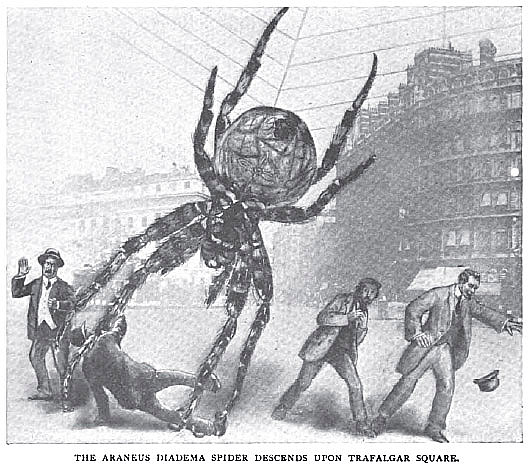
Araneus Diadema spider, Strand Magazine, 1910

“One day we will imagine London to have been startled by the sudden visitation of a monster Araneus diadema, somewhat larger than a mammoth, which, descending upon Trafalgar Square, seized a number of pedestrians in its jaws, and, having hastily dispatched them, proceeded to knock over a couple of the Landseer lions, under the impression that they were animated by hostile feelings, overturned a motor-bus, and, after doing as much damage above-ground as possible, insinuated itself into the Trafalgar Square station of the Underground Railway, where it became wedged in the tube, and was finally dispatched by concussion of the brain through colliding with an electrically-driven engine.

Yet the Araneus diadema has frequently been seen in the neighbourhood of Trafalgar Square. It is easy to imagine them hiding themselves in their silken cells spun amongst the leaves of the plain trees that adorn the Square; or hidden in the stones of the classic front of St. Martin’s Church. Only instead of being twenty or thirty feet in diameter, the spider with the foregoing name is but half an inch or so from head to tail, which, as I said before, ought to be regarded as a great mercy to mankind.

earwig, Strand Magazine, 1910

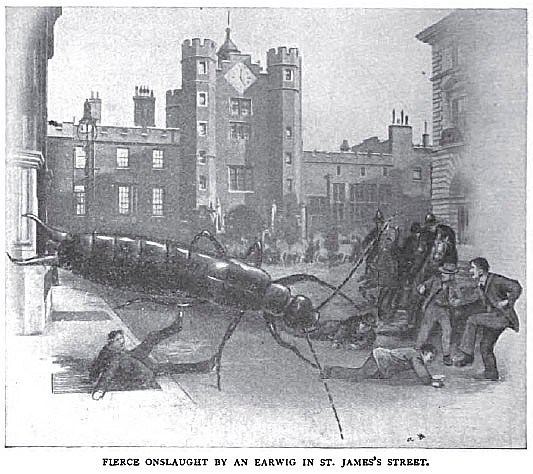
“Then we may easily fancy ourselves reading of the tragedy of the Dermapteron which one fine night tore out of the St. James’s Park, and for twelve hours held the fort at St. James’s Place until a regiment of soldiers succeeded in giving the grim monster his quietus. But at what cost! Eighty and more citizens and soldiers lay dead or mortally wounded at the bottom of Pall Mall. And the Dermapteron is not an imaginary insect, springing from the brain of Mr. Kipling or Mr. H. G. Wells, but our old familiar friend the earwig. A nocturnal insect is the earwig, with curved forceps at the end of its tail. They do not fly by day, but are very wide awake indeed at night, taking food and committing their depredations, as every gardener will tell you.

dragnfly, The Strand Magazine, 1910

house-fly, Strand Magazine, 1910

mosquito, Strand Magazine, 1910

grasshopper, Strand Magazine, 1910

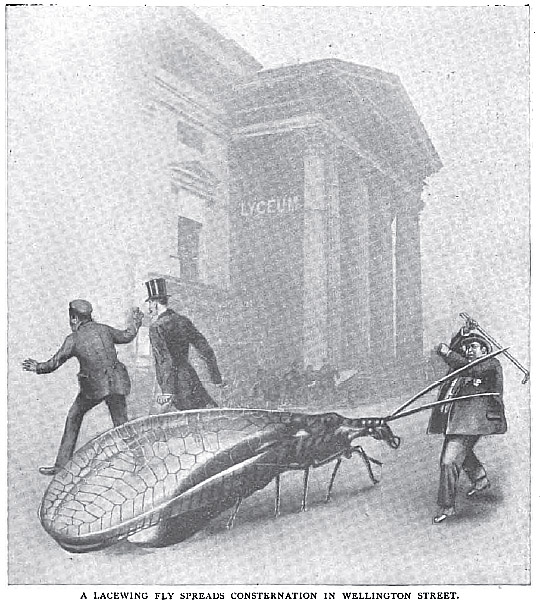
lacewing, Strand Magazine, 1910

“The lacewing fly, as my readers are aware, is a small, delicate insect with long and richly-veined wings of a tender green colour, like that of the body. Its antennae are long and tapering, and its prominent eyes shines like hemispheres of gold.

From this description we may surmise that were a lacewing fly to spring suddenly into magnified existence somewhere — say in the neighbourhood of the Lyceum Theatre, not magnified as we see it under a microscope, but a millionfold, the size of a monster alligator — the consequences, besides creating the utmost panic and alarm common to every cab accident, might be of a very serious nature, if they were seized with an appetite for walking gentlemen, chorus “ladies,” or even the harmless, necessary supernumerary.

Though I detect a healthy dose of entomological education in Mr. Kerner-Greenwood’s writing, most of the other articles written by him are all dry reference works concerning architecture. What brought this lovely gem into existence, we may never know, but it makes me mighty happy.


Posted in literature, wtf | Tagged , , , , , , | 1 Comment

Cyrus Tilton

As a semi-frequent attendee of the Oakland Art Murmur, an open-gallery art event that takes place every month, I have been lucky to be exposed to Cyrus Tilton’s works thanks to  Vessel Gallery.  Tilton’s sculptures are one of my favorite reasons for visiting this space; strips of cloth, plaster, rope and stone are wrapped around endoskeletons of wire and wood to create birds, beasts, and bodies full of animated character and dignified mystery.

Cyrus Tilton, The Cycle, 2001 (image courtesy Vessel Gallery)

Cyrus Tilton, The Cycle, 2001 (image courtesy Vessel Gallery)

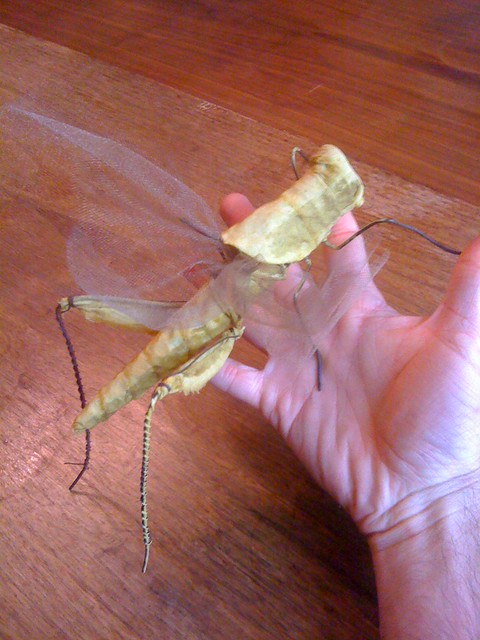
For the month of October, the entire two-story gallery is now playing host to an epic swarm. Humanity’s worrying propensity towards overpopulation and over-consumption is the starting point of Tilton’s latest project, The Cycle. What better animal to embody this fear than the short-horned grasshopper, known worldwide for their ability to transform themselves into swarming locusts? Well known for their agricultural destruction, locusts are often used as a mirror to humanity’s greed. On the downstairs floor, two immense locusts brazenly copulate, dwarfing the entrance to the gallery.  Muslin and beeswax (in place of glue) are stretched over an exacting framework of copper and steel. The attention to entomological detail is as astounding as their unapologetic exuberance.

Surrounding the two amorous acridids are several sculptures depicting grasshopper eggs after they have been shoved underneath the earth by the female’s ovipositor. However, instead of topsoil, these eggs are embedded into blocks of concrete, the unnatural substrate of civilization’s spread. The visual nods to scientific displays are no accident; Tilton is an art director at the Scientific Art Studio, which fabricates (among many other wonders) exhibits for science museums.

Cyrus Tilton, The Cycle, 2011 (image courtesy of Vessel Gallery)

Cyrus Tilton, The Cycle, 2011 (image courtesy of Vessel Gallery)

Upstairs the gallery is teeming with swarming locusts, a kinetic installation consisting of hundreds of wire-and-cloth insects suspended from swaying bamboo poles. Sitting in the middle of the swarm and listening to the live droning knob-twist work of Tilton’s brother, I felt like I was amidst a great mass of ominously hovering insects, just before they move en masse to despoil another hillside. Tilton and Vessel made this lovely filmshort of the swarm in action:

http://youtu.be/irnhyTrkrnU

Tilton had many volunteers who selflessly donated their time, helping him create the huge numbers of “individuals” upstairs. This kindled within him the hope that humanity would instead pattern itself after another allegorical type of insect, that of bees and ants, which are often portrayed as working together for the common good of the hive.

Cyrus Tilton, Individual #75, 2011

Cyrus Tilton, Individual #75, 2011

Incidentally, the smaller locusts are sold individually, 50% of the profits going to the Alameda Food Bank. Of course I had to get one. I now own 1/450th of a swarm!

The Cycle is at Vessel until October 29th, so go see it soon! I hope somebody commissions this fellow to make a swarm of the giant-sized locusts someday.  It would be incredible to see them covering entire buildings, nibbling away at our human-made hives. 

(grateful gallon of gryllids goes to Bug Girl, who tipped me off about this event!)
Posted in art, event | Tagged , , , , , , , | 4 Comments

The Golden Fleece

A couple of artisans

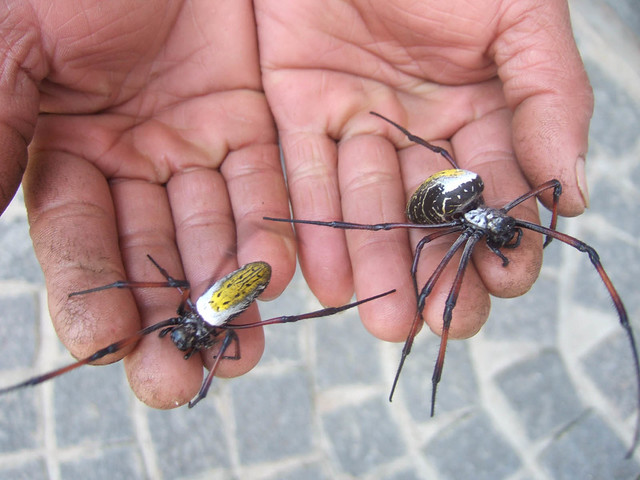
African Silk artists taking a breather to pose for pictures.

Like the endless nature documentaries that invariably used a football field as the default unit of measurement for flea-jumping, nearly every educational book or film that mentions spiders always talked about the incredible unrealized potential of spider silk. “Pound for pound, it is stronger than steel!” Other books got people to imagine what the properties of commercial spider thread would be like, if only it could exist, because of course it can’t. For somebody who consumed a metric ton of educational books about insects and spiders, such repeated factoids became tiresome. To paraphrase Warner, everybody talks about spider silk, but nobody does anything about it.

Which is what I initially assumed must have been what went through the minds of Simon Peers and Nicholas Godley when, after careful research, they attempted to actually put theories and history to test and weave silk thread from Nephila madagascariensis, the giant golden orb spider. The result is more than just an arachnological and sericultural curiosity. It’s a technical, artistic, and community-based triumph of the first order, an absolute wonder to behold. I know this for a fact, because I finally got to beholdify it with my own eyes at the Art Institute of Chicago, where it is on display for only another month! A happy coincidence with my brother-in-law’s wedding allowed me time to visit with family, so long as I could drag them with me to to the museum!

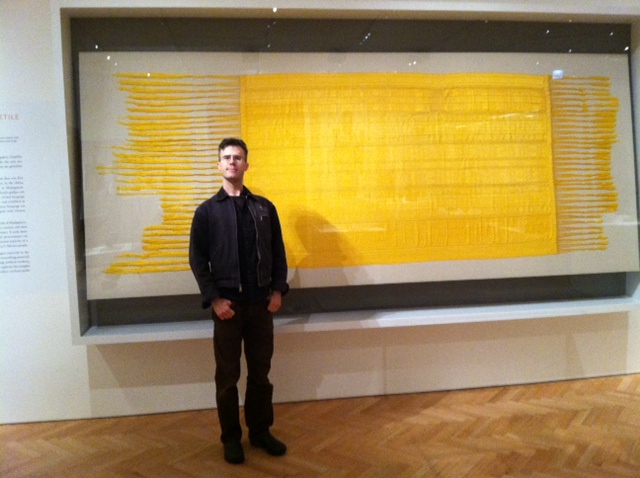
golden orb weaver tapestry

In this picture: myself, and the combined effort of a hundred humans and millions of arachnids.

Though I had read all about the history of its creation, there’s nothing like seeing such a thing in person, to peer at the fine diaphanous silk tassels, or to watch the light catch the traditional patterns woven throughout.  Despite its near-radioactive hue, the tapestry is in no way dyed. That’s raw Nephila silk, folks. Fascinatingly, the color is influenced by the spider’s diet. Subtle variations in the silk from each spider were evened out as the silk was mixed, lending it a uniform quality of golden brilliance.

Weaving of the Spider Silk Textile

Weaving of the Spider Silk Textile, image courtesy AMNH

Unlike hapless silkworms, cultivated by endless amounts of mulberry leaves, spiders are a limited wild resource, and while docile, are in no way domesticated. I love the descriptions of the weavers’ catch-and-release program:

  • “The spiders are harnessed … held down in a delicate way,” Godley says, “so you need people to do this who are very tactile so the spiders are not harmed. So there’s a chain of about 80 people who go out every morning at four o’clock, collect spiders, we get them in by 10 o’clock. They’re in boxes, they’re numbered, and then as they get silked, about 20 minutes later, they get released back into nature.”

If you haven’t seen it already, I highly recommend this 10-min video put forth by the Chicago Art Institute. It’s well done, and it also partially answers something that has been bothering me for a while, mostly about the history of spider sericulture. Most articles make light reference to the fact that spider silk was “tried once in the 1800s, then abandoned”, or other such one-liners. The AIC’s site, and their video, has a bit more:

  • “The idea of harnessing spider silk for weaving is an age-old dream that was first
    attempted in a methodical way in France in the early 18th century. In the 1880s,
    Father Paul Camboué, a French Jesuit priest, brought the dream to Madagascar.
    Intrigued by the strength and beauty of the silk produced by the island’s golden orb
    spider, he began to collect and experiment with it. In 1900 a set of bed hangings
    was woven from spider silk at Madagascar’s Ecole Professionelle and exhibited at
    the Exposition Universelle in Paris (today the whereabouts of those hangings are
    unknown). But the idea of creating an industry that could compete with Chinese
    silk (produced from silkworms) proved unrealistic. “

But who is this guy Camboué ? Sadly, even pictures of the fellow on the internet are hard to come by, though there’s a couple in the AIC video. He looks like an interesting character, and after a little digging I was able to find this lovely account:

  • Camboué was prolific, and produced a variety of written works. He was a “bush missionary” who largely worked west of the capitol, in Arivonimamo and Ambohibeloma. He related his concerns to others in a steady stream of correspondence, and many of his letters were published in missionary journals of that time. He was also interested in studying Malagasy behavior and morals, customs, and art. However, his renown came largely through his accomplishments in the field of natural science, principally in the study of invertebrates.

The link here has but a partial list of his contributions to entomology. In my opinion Father Camboué was kind of a badass, the sort of unstoppable inventor and discoverer in the manner of Athanasius Kircher. Not only did he publish all these works, it is his machines and techniques that Peers and Godley used when building their own spider-silk tapestry. Sadly I do not have the research chops to find any illustrations or descriptions of Camboué’s inventions online, for I’d love to find out more about him, (instead of just as a footnote to the current spider tapestry). By the way, you can see in the video, tantalizingly, a little of the devices used to harvest the dragline silk of the Nephila spiders.

The tapestry is on loan in the Chicago Art Institute’s newly renovated African art gallery, a vibrant and brightly lit environment that emphasizes the art in historical and geographic context. The tapestry itself is a wonderful example of living African art and culture, as the weaving itself is made with precolonial patterns of the local Madagascar Merina peoples, a tradition revived in part by Peers’ Lamba SARL weaving cooperative.

I am not sure where it is traveling to after Chicago, so if you’re anywhere near Illinois and want to gaze at the one-of-a-kind spidery wonder of the textile world, see it soon!

Posted in art, fashion, JD, spider | Tagged , , , , , , , | 1 Comment

Endless Swarm, Swarm, SWARM!

http://youtu.be/4GsGcqmmRd8

Cartoon Tuesday! Found this lovely bee-filled gem from my youth. In the 80’s, Marvel put Spider-Man in cartoons again, but this time paired with two other Marvel characters, where they all lived in the classic apartment-that-with-a-switch-of-a-lever-becomes-a-computer-filled-crime-fighting-lab. Anyways, this episode was unsurprisingly one of my favorites. I totally wanted to be Swarm, despite the fear of communes this show was trying to instill upon Reagan-era capitalist youth. Swarm, swarm, swarm swarmmmm!!!!!

Posted in film | Tagged , , | Leave a comment

Moths Under My Nose

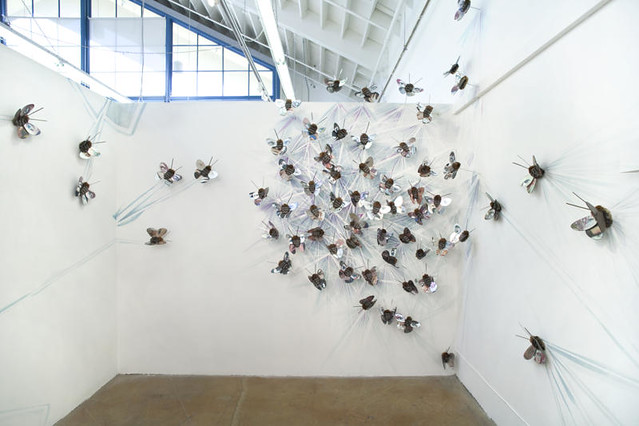
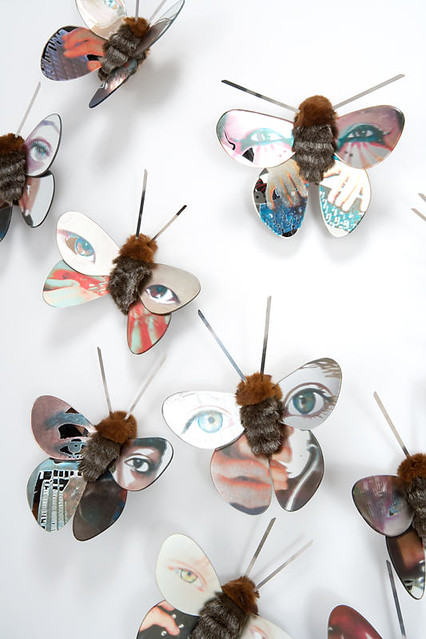
Continuing an unfortunate trend in local insect-related art shows that I have missed, here are some works from Bay Area artist Ana Labastida.  Her installation “Pullulate” is just one of several works involving moths and swarms, and was recently on display at the aptly named Swarm Gallery in Oakland. All her works are made out of recycled materials.

Ana Labastida, Pullulate, 2011

Ana Labastida, Pullulate, 2011

Ana Labastida, Pullulate (detail), 2011

Ana Labastida, Pullulate (detail), 2011

Who doesn’t love moths with eyeballs? Find me that person, if you can. I know predators don’t like them, but I think they’re keen.
Ana Labastida

Ana Labastida, Drive in the dandelion fields, 2009

Ana Labastida

Ana Labastida, I have the certainty of being like the Summer, 2009

To prevent future gallery attendanceFail, I have taken the advice of culturevore Engineer’s Daughter and am now keeping a closer watch of art-announcement sites like Happenstand. I am determined to catch all insect art in the butterfly-net of my retinas! 

Posted in art | Tagged , , | Leave a comment

The Hybrids of Paul Paiement

There’s something gleefully unsettling about Paul Paiement’s “Hybrid” paintings. They seem innocent enough, a straightforward pop-art treatment of entomological portraits spliced with consumer products. But Paiement’s works lack any sort of easy symmetry, and as the eye is pulled back and forth picking out the details, paint tubes get snuck into pronotums, and mp3 players play Mullerian mimicry with coccinellids. Oversized half-tone patterns bleed over the images, recalling acid-blotter art. Moreover, what appear at first to be digital photo-collages are in fact egg tempuras, acrylics, and photogravures, all in service to enjoyable visual and entomological puns and humor, right down to their scientifically-named paintings.

Paul Paiement, Coccinella Mpthreeus, 2007

Paul Paiement, Coccinella Mpthreeus, 2007


Paul Paiement, Plinthocoelium Nosehair, 2009

Paul Paiement, Plinthocoelium Nosehair, 2009

Paul Paiement,  Hypsopygia Oceanea, 2009

Paul Paiement, Hypsopygia Oceanea, 2009

Paul Paiement, Callicore Videocamerae, 2008

Paul Paiement, Callicore Videocamerae, 2008

Paul Paiement, Chrysochroa Raja Flashdriveus, 2005

Paul Paiement, Chrysochroa Raja Flashdriveus, 2005

Paul Paiement, Chrysina Smartcarius (installation at Marx & Zavattero Gallery), 2009

Paul Paiement, Chrysina Smartcarius (installation at Marx & Zavattero Gallery), 2009

Though a great many of them are collected in book form, Here’s hoping his works turn up in a gallery again soon. I would love to see these up close!

Posted in art | Tagged , | 1 Comment

Stridulation Friday

This evening I’m making a cardboard green-bottle fly in the garage, and listening to Hank Williams:

Happy Friday!

Posted in music | Tagged , | Leave a comment

The Curse of Fear

One of my favorite kinds of literary formats in high school was (and still is) the Science Fiction Anthology. A grab-bag of styles and ideas, I never knew what to expect.  Greedily pulling down every Nebula Awards, Science Fiction Hall of Fame, or Year’s Best SF, I was introduced to editors like Asimov, Bova and Greenberg, and untold numbers of authors. It was how I first learned about Ray Bradbury, Alfred Bester, Philip K. Dick, and James Tiptree, Jr. I knew Frank Herbert from his weird short stories long before I ever cracked open Dune.

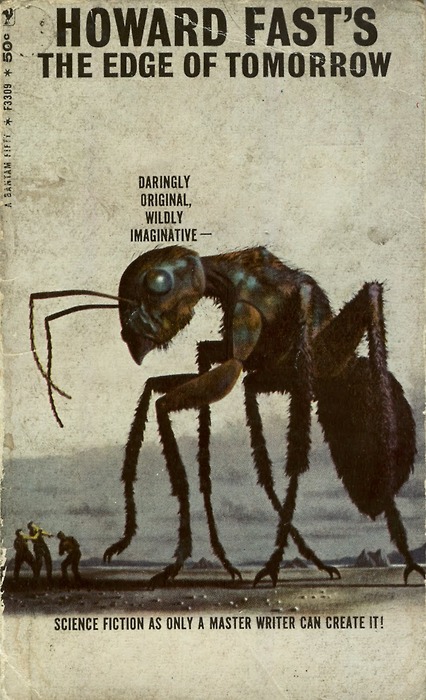
howard fast edge of tomorrowMost of these stories were from the ’50s and ’60s, and with them an obsession with the early Cold War, healthy dollops of sexism, and equally incomprehensible (to me) allusions to the Bible. But the stories stayed with me, some fondly resurfacing from my literary past, perhaps now making more  (or less) sense to me as I got older.
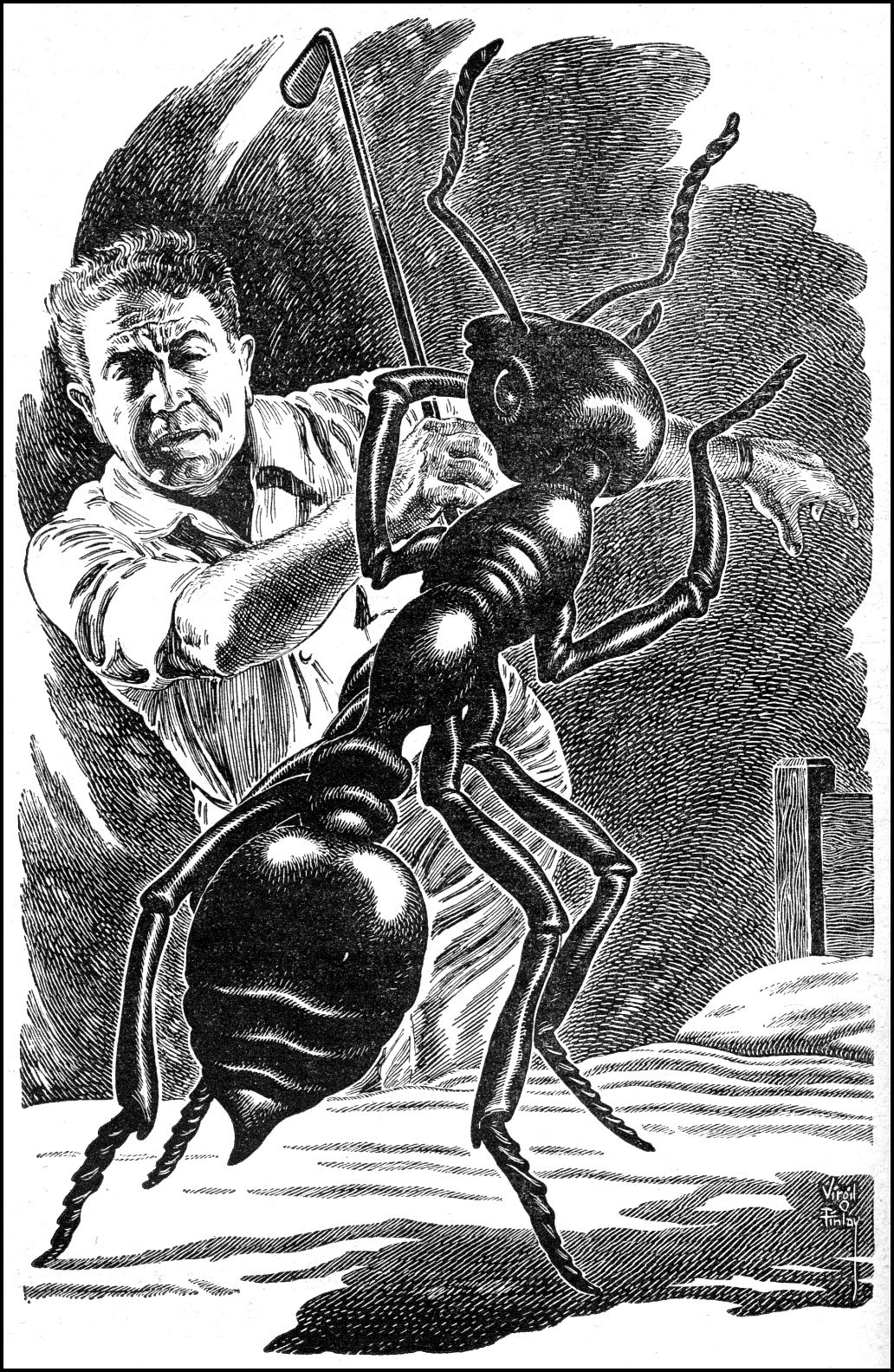
One of these stories resurfaced recently, a very short 1960 story by Howard Fast titled, “The Large Ant”. I had no idea at the time of Fast’s repertoire,  but of course any short story about large ants was bound to leave an impression on me. I recently got hold of an old paperback by Fast containing that story, and re-read it after 25 years. The paperback has a glorious uncredited cover showing a colossal ant terrorizing puny humans on the cover. Which is even more amusing when you realize that Fast’s tale is about an ant a 100th of that size, though the fear factor is the same.

In the story a man on vacation named Morgan finds a large ant, “fourteen inches long” slowly crawling on his bed. Instinctively he grabs a golf club and kills it dead.  Later he takes the carcass to an entomologist, who is curiously joined by two representatives from the government, and they are all gravely interested in Morgan’s find.

   Lieberman said, “You are an intelligent man, Mr. Morgan. Let me show you something.” He then opened the doors of one of the wall cupboards, and there eight jars of formaldehyde and in each jar, a specimen like mine- and in each case mutilated by the violence of death.
Lieberman closed the cupboard doors. “All in five days,” he shrugged.
“A new race of ants,” I whispered stupidly.
“No. They’re not ants. Come here!” He motioned me to the desk and the other two joined me. Lieberman took a set of dissecting instruments out of his drawer, used one to turn the thing over and then pointed to the underpart of what would be the thorax of an insect.
“That looks like part of him, doesn’t it, Mr. Morgan?”
“Yes, it does.”
Using two of the tools, he found a fissure and pried the bottom apart. It came open like the belly of a bomber; it was a pocket, a pouch, a receptacle that the thing wore, and in it were four beautiful little tools or instruments or weapons, each about an inch and a half long. They were beautiful the way any object of functional purpose and loving creation is beautiful- the way the creature itself would have been beautiful, had it not been an insect and myself a man. Using tweezers, Lieberman took each instrument off the brackets that held it, offering each to me. And i took each one, felt it, examined it, and then put it down.
I had to look at the ant now, and I realized that I had not truly looked at it before. We don’t look carefully at a thing that is horrible or repugnant to us. You can’t look at anything through a screen of hatred. But now the hatred and the fear were dilute, and as I looked, I realized it was not an ant although like an ant. It was nothing that I had ever seen or dreamed of.
All three men were watching me, and suddenly I was on the defensive. “I didn’t know! What do you expect when you see an insect that size?”
Lieberman nodded
“What in the name of God is it?”
“We don’t know,” Hopper said. “We don’t’ know what it is.”.

Virgil Finlay, "The Large Ant"

illustration by Virgil Finlay

The story turns on the assumption that human nature is unalterable, and that humans are instinctively afraid and horrified by the unknown in general, and insects in particular. When Morgan kills the large ant, he can’t even bring himself to look at it due to shaking disgust and fear. And now his human nature, the “curse of fear,” has resulted in the death of an intelligent being;

I keep trying to drag out of my memory a clear picture of what it looked like, whether behind that chitinous face and the two gently waving antennae there was any evidence of fear and anger. But the clearer the memory becomes, the more I seem to recall a certain wonderful dignity and repose. Not fear and anger.


“But tell me – where do these things come from?”
“It almost doesn’t matter where they come from,” Lieberman said hopelessly. “Perhaps from another planet- perhaps from inside this one- or the moon or Mars. That doesn’t matter. Meanwhile, they have the problem of murder and what to do with it. Heaven knows how many of them have died in other places – Africa, Asia, Europe.”

During a time of intense anxiety from the threat of nuclear war, it wasn’t a stretch to assume an alien intelligence would be met with fear and violence from our species. in 1960, it seemed like we were ready to extinguish ourselves with both. The story ends with Morgan and the other gentlemen waxing fatalistic about humanity’s chances. After all, who can resist killing a large insect?

Well by this time you probably guessed, even when I was a young lad I found this conceit rather implausible. Ask anybody who loves insects, or biology in general, and I think their first instinct would be not to kill, but to capture, or at least properly ID a fourteen-inch ant. I believe further that entomophobia and arachnophobia are not instinctive, but learned traits. Children need to be taught to fear spiders and beetles. Toddlers have only fascination at the curious creatures that are down at their level. But it doesn’t take long to walk about and find a grown adult who is scared pantless by the sight of a cockroach, or house spider, or any other invertebrate. In California especially, where disease or injury from insects is especially rare, people run screaming from harmless Jerusalem crickets, of all things.

Which is why this story struck a chord with me then as it does now. If we can’t find awe and wonder in our fellow life forms on Earth, how will we fare when tick-shaped aliens from Planet Ixodon come calling? Probably still rather poorly, but better than Howard Fast’s prediction. I also like to think we’ve advanced a little farther through education about the world we live in. If the “curse of fear” is learned, so can the “curse of curiosity”. To paraphrase Kermit the Muppet, That’s the kind of curse that gets better the more people you share it with.

Posted in literature | Tagged , , | 1 Comment

The Metal Insects of Edouard Martinet

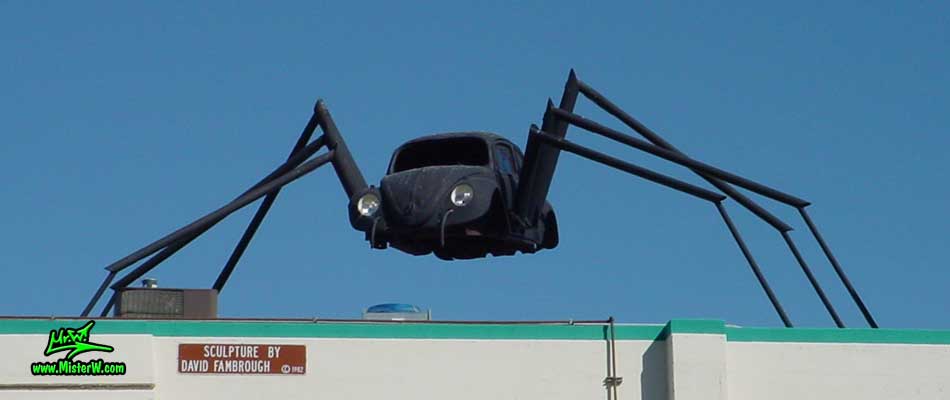
Don’t get me wrong. I love kitschy scrap-iron insects, even goofy ones made from VW Beetles. But the scrap-metal works of Edouard Martinet are on another plane of mechanistic existence.  More than abstract robo-insects, we’re looking at accurate depictions of invertebrates, carefully assembled through selected mechanical parts. Let’s just bask in the bicycle-chain tarsi, shall we?


Images above giddily linked from awesome artblog Colossal and the Sladmore Gallery, where there is a heaping helping of insects, fish, frogs, and birds, all made from bits of machinery. The recipe for the grasshopper lists as thus:

Wings: Moped chain guards; abdomen: bike fender, dolex fender and old toys; rear legs: bike forks; forelegs: bike brakes; ends of legs: plugs for plaster walls; thorax and head: pieces of cars and bikes; antennae: bike spokes.

Though many other metal artists have similar recipes, the vintage parts in Martinet’s works are allowed to retain their individual histories, all while contributing to the sensibility of the living creature. The enjoyment of his works are heightened when you can accurately detect a vintage motorcycle headlamp in a beetle’s elytra, or car mirror fixtures in a damselfly’s distal coxae. As a sometime creator of assembled artworks, the sheer time and patience needed in order to assemble an accurate insect from metal parts is staggering and inspiring to me. 


Posted in art | 2 Comments

Hairy Stills

Lasiodora paraphybana

Guido Mocafico, Lasiodora paraphybana, 2003

Guido Mocafico, Psalmopoeus irminia, 2003

Guido Mocafico, Psalmopoeus irminia, 2003

Guido Mocafico, Acanthoscurria geniculata, 2003

Guido Mocafico, Acanthoscurria geniculata, 2003

Though Parisian artist Guido Mocafico has received lots of attention for his beautiful photography of snakes, I love this hairy series of his, collectively called Aranea. His site also has a wonderful collection of jellyfish portraits, and photographs done in the style of Dutch still lifes. I would love to see what an arachnid-filled Dutch still life would be like; a sumptuous bouquet of spiders over an elegantly set table…

Posted in photography, spider | Tagged , | 2 Comments