Anton Fell, Microscopic Milliner

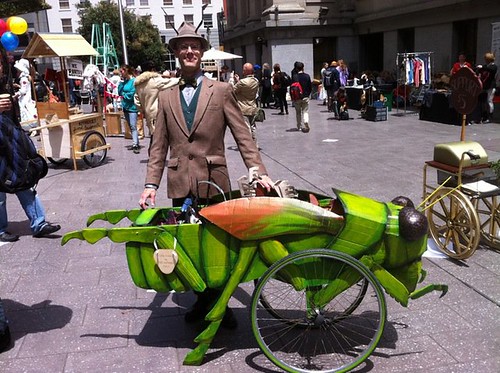
On Saturday June 11, 2011, about 50 artists swarmed the public streets of San Francisco, hawking their wares carried in carts, in baskets, or on their backs. Some sold real items, others bartered or even exchanged intangible goods, like stories.  Among those itinerant art-merchants was “microscopic milliner” Anton Fell, known far and wide as the Antenna Fella.
The initial idea for Anton Fell came from a suggestion by Aimee Baldwin, an artist who creates incredibly realistic paper birds. Aimee was participating in the group art event “The Cries of San Francisco“, a project by Allison Smith in collaboration with  Southern Exposure Gallery. Inspired, I immediately started creating insect antennae to sell to the masses!  But instead of relying on beloved insects such as ladybugs and butterflies, I instead chose to represent insects from the “unloved orders”, insects and arachnids considered as pests, and ones generally under-appreciated.
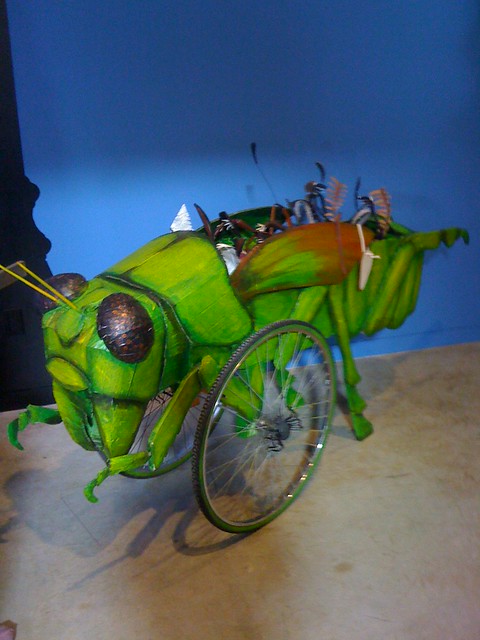
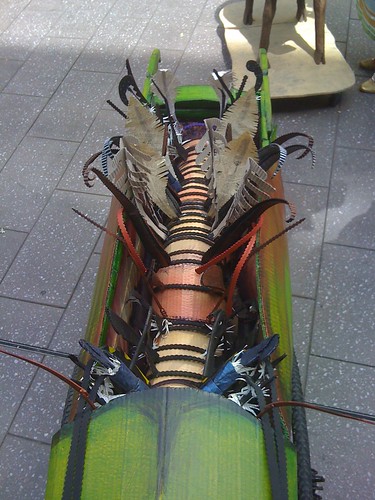
Grasshopper Cart, by John Daniel

Grasshopper Cart, by John Daniel

Carrying antennae around on my person was out of the question, they were too ungainly. So I built a great grasshopper cart using scrap wood and cardboard, purchasing a pair of old bicycle wheels from a community bicycle restoration center.  Originally it was going to be a “weevil wagon”, but after the main body began to take shape, I decided to make it an easily recognizable insect, a locust.   The “grasshopper cart” had a central tube of cardboard inside it, so the antennae could be stored upright. It was painted to look like its digestive tract, allowing me to give it wonderful “bug gut” colors inside. Mmm, guts!


At the gallery opening, dressed as a cross between a school professor and a door-to-door salesman, I sang my cries to any and all to buy my wares:

Plumose and Serrate
Filiform and Lamellate
Antennae for sale…!
Insect Antennae, by John Daniel

Insect Antennae, by John Daniel

The cart was stocked with 20 pairs antennae of unloved insects and arthropods: head louse, bed bug, cockroach, millipede, tick, gypsy moth, clothes moth, boll weevil, termite, Argentine ant, earwig, and others. I even included a couple of better-loved insects, such as stag beetle and antlion. I anticipated a hard sell, which really was my goal; rather than sell as many antennae as possible, my desire was to talk about people’s revulsion to insects, and convince them that even the least loved creatures have fascinating, and even beautiful, lives. If I could convince somebody to appreciate a silverfish or earwig, then I have lit a new candle of biophilic empathy.

I did not anticipate that I would sell out, completely. I had naively priced them to go, and everybody came up and bought them. They loved them. I was beswarmed! Soon antennae were bobbing hither and to in the market-space Southern Exposure had created in their gallery.  It was a swell evening, but that meant I had better make more antennae for the June 11 market day. A lot more.
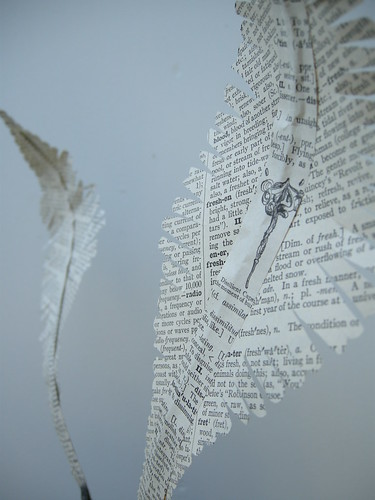
Gypsy Moth Antennae (detail)

Gypsy Moth Antennae (detail)

Due to the outdoor event getting rescheduled due to an unseasonable rainstorm in the Bay Area, I had two weeks to go into production mode. I made multiples of every species, resulting in a whopping 62 hand-made antennae. The line-up this time consisted only of “un-loved” insect antennae: Head Louse, Yellowjacket, Gypsy Moth, Boll Weevil, Argentine Ant, Bed Bug, Cockroach, Termite, Carpet Beetle, Clothes Moth, Jerusalem Cricket, Silverfish, Earwig, Flea, Mosquito, Light Brown Apple Moth, Horse Fly,  along with Tick and Dust Mite pedipalps. Each headband came with an identification tag, and a little sentence extolling their virtues. “The mellifluous MOSQUITO sings for its supper in the warm Summer nights!”, and so on.

The sunny beautiful Saturday found San Francisco’s Mint Plaza thronged with artists of every stripe, craftspeople with carts, booths selling prints, heritage seeds or hand-sewn wounds, conceptual political artists, as well as even more esoteric sellers of dreams, time, and hope. It was a loud chaotic wonderful throng, and I happily lost myself in it, expounding upon the virtues of insects to any within earshot.  And since I am naturally a Very Loud Person, my range of earshot was long indeed, thanks to the plazas and tall buildings.
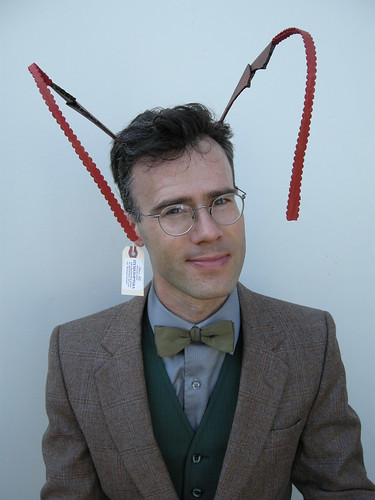
Argentine Ant Antennae by John Daniel

Argentine Ant Antennae by John Daniel

My opening line of “Which insect do you love the least? “, then fitting them with the antennae of their nemesis, created some wonderful conversations. Schoolteachers flinched when I handed them louse antennae.  New Yorkers shivered at the mere mention of bed bugs, and were scared to even touch the cardboard-and-paper antennae. Several times I was approached by people who knew their entomology; “Have you any Reduviids?” “No, I’m out of Kissing Bugs, perhaps I can interest you in a mosquito? They also harbor trypanosomes!” “Ooh, you’re good!”

Some people had deep connections to the antennae they purchased. One older gentleman, at the mention of my tick pedipalps, declared that he had finally been cured of Lyme disease, after ten years of antibiotics. He then triumphantly purchased the tick pedipalps as “a talisman” after his long ordeal.  That was a personally humbling thing to witness.

Once again, by the day’s end, I had sold every pair of insect antennae to friends and strangers alike. The most awesome thing was to look all around me in Mint Plaza and see antennae in the crowd: There, a dust mite laughing. Running, a pair of fleas. At another booth, an earwig dancing. Endless forms most beautiful!

By the way, the Grasshopper Cart, along with many other carts, booths and artworks by participants, will be on display until July 2nd at Southern Exposure Gallery in SF. Check it out while you can.

Posted in art, event, JD | Tagged , , , , , , , , , , , , | 7 Comments

Will the FDA-Approved Chapuline Please Stand Up?

So apparently the SF Health Department has prohibited a local San Francisco restaurant from selling chapulines (Mexican grasshoppers) to the public, because the source was not FDA approved. This isn’t the bad news.

I had no idea that I could have been dining on these all this time, and now sadly, it’s too late! At least until they find a way to assuage the FDA, or raise grasshoppers locally. The only place I knew that was selling this Oaxacan treat was in East Los Angeles, so I am doubly unhappy now.  They look so delicious! However, this isn’t the bad news.

The bad news is lead. Ridiculously high amounts of lead. That’s bad news enough. The really bad news is how the poisoning happens- It’s not from the grasshoppers themselves. epidemiologists from UC Davis and UC San Francisco started tracking the trail of how entire populations have increased the lead levels in their blood, and found a net of culture, cuisine, and tradition that will be hard to unravel. One of the sources is how they are prepared: the chapulines are ground up with spices, using large ceramic bowls. The bowls are traditionally given a thick glaze. Over time the brilliant blue glaze grinds off into the dish, and that glaze is filled with lead. There’s still more things that researchers don’t know (the article is just a tip of the research iceberg) But one thing’s for sure, despite my hunger for delicious grasshopper snacks, I’m going to have to wait a little longer until  I try chapulines.

Posted in cuisine, insect | Tagged , , , | Leave a comment

The swarming paper of Kristi Malakoff

Swarms, whether fish, foul, or flies, are a constant source of wonder and fascination for humans, as well as a frustration. We lack lateral lines or instinctive reactions, and  so our attempts to swarm usually result in chaotic crowds and gridlocked highways. Though we can train ourselves to coordinate and synchronize small groups of humans, this ability tapers off rather dramatically when we go from 20 to 1,000 to 100,000.  It is no wonder then that the undulating flocks of starlings or amoeboid foragings of army ants are often the subject of both intense scientific study, and of art.  Swarming is our fellow animals at their most alien.

Kristi Malakoff‘s cut-out installations in paper and wood are built on that alien wonder, and exploit it to the fullest, the carefully cut individual creatures spilling out over gallery walls, floors, and ceilings, taking up the entire volume of the gallery, or just huddled in a corner. The last example is my personal favorite, her 2008 work Resting Swarm:

Resting Swarm by Kristi Malakoff

More than 20,000 hand-cut honeybees cluster in the corner, its small size belying the staggering potential such a population should it suddenly decide to take to the air.

Resting Swarm by Kristi Malakoff

Resting Swarm by Kristi Malakoff

Swarm by Kristi Malakoff

Swarm by Kristi Malakoff (detail)

Posted in art, insect | Tagged , , , , | Leave a comment

Catherine Jeffery Jones

Random search of comics blog turned up this image from fantasy artist Catherine Jeffery Jones, who passed away last week.

Fantastic by Catherine Jeffery Jones

It’s not every day you see a ‘Frazetta’ girl ride a tabanid horse fly! Catherine Jeffery Jones was a transgendered artist, a giant in the fantasy illustration world whom Frazetta himself called “The greatest living painter.”


Posted in art | Tagged , | Leave a comment

Geekiest Site Ever

When an evolutionary developmental biology professor/scienceblogger of PZ Myers‘ status calls your site “The geekiest website ever“, you know you’ve made something special. Or at least really really really geeky!

Occlupanid X-ray

I’m riding a super sci-nerd high today!

Posted in science, wtf | Tagged , , , , | Leave a comment

We have met the locusts

Locusts by Kate MacDowall

Directly challenging the romantic notion of humanity’s ideal union with the natural world, Kate MacDowell‘s haunting and intricate porcelain sculptures are each one worthy as a symbol of our combined dependance and destruction of the world we inhabit. Her portfolio page is a barrage of provocative works, but even though many have clever wordplay titles, none feel like one-note ideas, allowing for deeper interpretation as she peels back the skin to reveal how deep roots and ruin are intertwined.  Each hand-built piece is rendered in the same translucent white porcelain, giving a sense of un-life to each specimen.

Though much of her art is vertebrate-based, there is some wonderful attention paid to our uncomfortable and complicated relationship with insects. Greedy grasshoppers use human hands to shove corn into their mouthparts, merging our unceasing hunger for monoculture with that of an unstoppable locust swarm.  In an even more sombre work, invasive organisms- invertebrates and plants spread by accident or design- issue from a beautiful woman’s mouth like sores, transmitting ecological disease wherever she goes.

Invasive Flora by Kate MacDowell

Posted in art | Tagged , , , | 1 Comment

Katherine McDowell Patterson

Katherine McDowell Patterson, moth on web

Moth On Web, by Katherine McDowell Patterson

Plenty of butterflies and spiderwebs (and vertebrates, if that’s your thing) by Katherine McDowell Patterson

Posted in art, insect, spider | Tagged , , | Leave a comment

Time considered as a helix of semi-precious enzymes

Loom is a fantastic animation about a moment that occurs in the fractions of seconds, when a spider attacks a moth. It’s beautiful, dramatic, and poetic. That may seem like jarring adjectives for what looks like an evil horrid spider bearing down on a sweet little moth while overly glitchy noise music clicks around, but bear with me as I explain:

I am normally not a fan of the current fashion of rapid time-remapping in movies. Sometimes it adds to the sense of drama or action, but mostly it’s just gimmicky camera-tricks. I’ll happily forgive Loom’s time-shifting though. The time-shifting allows us to really get into something that takes place in the blink of an eye in the natural world. It also helps us shift our perspective from the trapped moth to the spider herself. After a feint at grabbing her prey, she manages to make her catch. There’s a violent and determined bite, and then a slow embrace as her arms wrap around. And then the really poetic stuff starts.

I mean, has the breakdown of a moth’s organic components and reintegration into a spider’s body ever been rendered with more artistic molecular awesomeness? The attention to biological and molecular detail is matched by the abstracted delight of the concept.

Polynoid has a history of works that celebrate the small scale. They also created 458nm, aka the “biomechanical snail movie”, along with many other works of biomorphic beauty. Mindplotter is another, very keen!

Posted in film, spider | Tagged , , , , , | Leave a comment

Support your local Cicada Princess!

A truly multi-talented and endlessly creative local film maker, Mauricio Baiocchi, is also a good friend of mine. He’s been hard at work on a labor of serious insect love. It’s called Cicada Princess, a film about the life cycles of cicadas and the the party they throw themselves at the end of their lives.  They’re putting the word out to get funding, and I hope they do, because it looks absolutely stunning. He’s assembled a great team, and they’re even offering some of the beautiful insect puppets for donations.  Check out the short promo clip where Mauchi talks about his big heart for his favorite Hemipteran:

http://vimeo.com/23991329

Let’s help get this made! The world needs more insect art films!

Posted in event, film | Tagged , , , | Leave a comment

Diplopod Zen

Making insect antennae all day for an upcoming show.. here is a moment of zen I found while hunting for images of millipede antennae.

Seriously, is there nothing more relaxing than watching one of those guys? Relax, slow down, chew some lichen, and if anybody pisses you off, curl up and secrete hydrocyanin.

Posted in photography, Uncategorized | Tagged , | Leave a comment