Wonders beneath your feet

This is an absolutely wonderful article about a new discovery: Tarantulas not only posses spinnerets, but have silk glands on their feet. Wired News has a picture-laden article about the whole silky saga. This enables the heavy arachnids to climb sheer surfaces without slipping and falling to their deaths. (tarantulas, even tree-living species, have delicate exoskeletons, and even a 5-foot fall on a floor could be fatal to many)

A few simple experiments in the Journal of Experimental Biology proved that indeed tarantulas were able to climb sheer glass surfaces with tiny silk safety-lines in each of their tarsi.  What’s even cooler is that the pores that produced the silk were already known and documented:

SEM photograph of setae on tarantula foot, showing silk-producing pore

Both setae (flat strands) and spigot structures (thin, bright strands) are visible in this shot, which is about 0.01 of a millimeter wide. Before Rind’s team took these images, the spigots were assumed to be heat-sensitive hairs. “Arachnologists spotted [the spigots] 20 or 30 years ago but, as far as I know, nobody described their function,” Rind said. “It’s a little surprising with a creature as well-studied as a tarantula.”

I really dig this story because it shows that there are marvelous things to learn even about well-known and documented organisms, and that simple curiosity and science can lead to even more wonder about the world. (It also shows how ruthless peer-review can bring about better experiments.)

Posted in science, spider | Tagged , , , | Leave a comment

Covered in BEES pt. 2

Last Friday I visited my friend Darrel at his place in El Sobrante.  His land was alive with inventive sustainable architecture, beautiful bamboo, and insects of course! In addition to getting a tour of all the species of bamboo on his property, I was treated to some honey straight from the comb of his beehive!

Bamboolandia Beehive

As much as I love insects, the only arthropod I have ever kept in captivity is a giant African millipede while I was in college, which I named Clarke-Nova. I have never had an “ant farm”, and have never kept bees.  So I was unsure how to react when Darrel just walked over without any protective gear and started pulling up a frame with his bare hands and a knife. Don’t you need smoke? Or cool mesh-topped hats and suits? “They’re really docile,” says Darrel, “As long as you move slowly, there’s just no problem.”

Darrel takes a stab

He held out the frame, gently shook off a few bees at the top, then used his knife to cut out some comb. It flopped down on a cardboard box, trapping several bees underneath. I gingerly flopped it over, and allowed the frustrated workers to get out from the sticky mess. One of the hapless bees was of a caste I rarely see: a drone. Drones are the male bees, and don’t do any work, and mostly laze about until it’s time to mate. They’re slightly larger than the female workers, and have larger, almost fly-like eyes as well. They also have no stingers, so I picked him up by the scruff of his thorax, and could feel the vibrating internal wing muscles beating like a power tool as I took a closer look to his stocky build.

Setting him down with his sisters, I then treated myself to probably the best and freshest honey I’d had in years. I was hit by a full quarter cup of pure undiluted unfiltered bee vomit, and was blasted to another level of insect love as the hive swarmed over me, the workers either licking up spilled honey, or simply going about their business as if nothing was the matter. Also, no chaw ever existed that beats honeycomb. Wax from bee glands is the best!

Seriously, this shit got me high

Mmm, now I want to be covered in BEES!


Posted in event, insect | Tagged , , , | 2 Comments

Covered in BEES

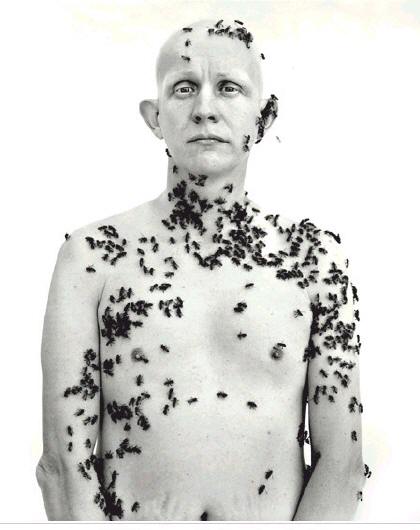
"Ronald Fischer, Beekeeper" by Richard Avedon

In 1981 farmer and beekeeper Ron Fischer answered an ad in a national beekeeping journal seeking a man or woman willing to be photographed with bees by a “world-famous photographer.” That photographer turned out to be Richard Avedon. Here’s a nifty article about how he became the “Bee Man of Orion“. The photo is a favorite of mine, not just for its surreal nature, but because it portrays somebody nonchalantly with a swarm of insects,

photo from "Working with Avedon" by Laura Wilson

To get the bees to land on Fischer, a university entomologist he was acquainted with patted queen bee pheromone (an attractant for other bees) onto several spots on Fischer’s head and chest.

Then, about 200 feet away, packages of bees were opened on the ground. The bees detected the pheromone and began to move.

Fischer still remembers watching the swarm of bees heading his way.

“They started forming a cloud over my head,” he says.


Posted in art, photography | Tagged , , , , | 1 Comment

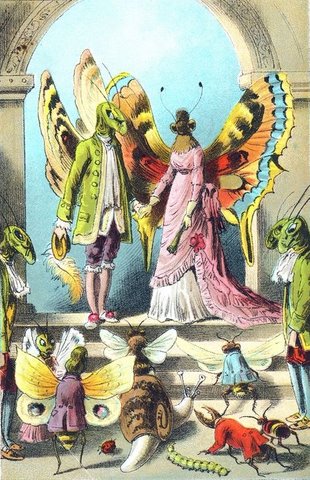
Insect Ball

Biomorphic glass artist Alexis Berger sent me this lovely vintage illustration to cheer me up during my weekend of flu.  I love the attendees, especially the obscure eyed lantern bug in the foreground!

Posted in art | Tagged , , , , | Leave a comment

The True Bug Blues

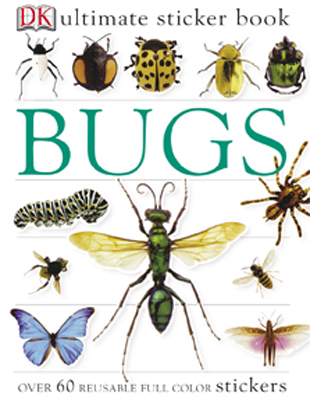
If there’s one vernacular name that drives me crazy, it’s “Bug”.  An ancient word still in use today that can refer to an insect, spider, woodlouse, centipede, lobster, bacterium, computer error, or a pug/Boston terrier mix. Or just possibly, it refers to an actual bug. You know what that is, right? Here’s a picture to help you:

dk BUGS sticker book

sticker-book taxonomy FAIL

Whoops sorry no bugs there. There’s beetles, butterflies, wasps, a grasshopper, a fly and a big tarantula. But no bugs. At all.

What’s even worse is popular books about invertebrates written by naturalists use the term terribly loosely, just because it’s a word people recognize. Here’s the cover of one of my favorite photo-reference books, a giant tome with an unfortunate title:

Can you spot the "bug" ?

Here it seems to indicate that “bugs” are somehow different then insects, and the authors use the term loosely throughout the book to denote arthropods that aren’t insects. Or possibly arthropods in general. The only non-insect on that cover is a centipede, by the way.

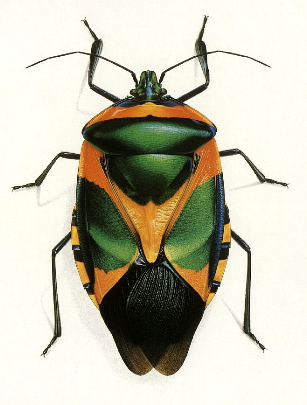
THIS is a bug, people. And it’s an insect:

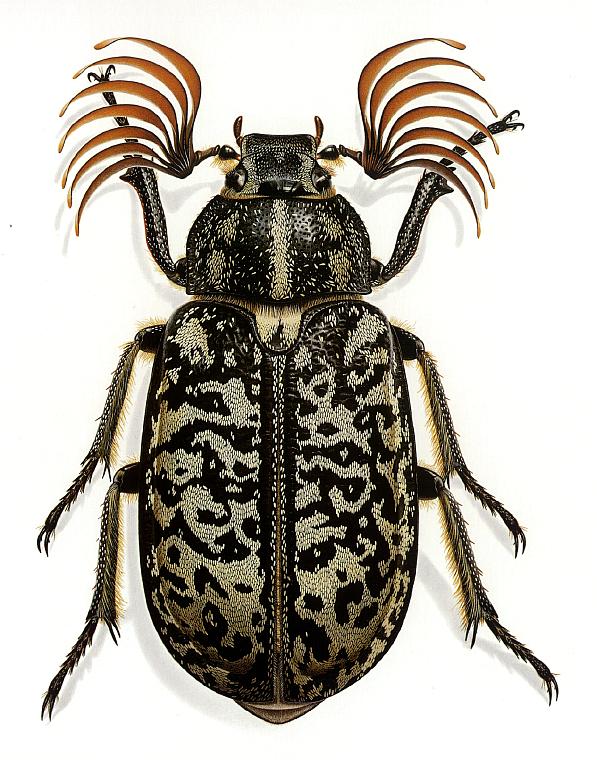
Shield Bug by Bernard Durin

Shield Bug by Bernard Durin

Ain’t it pretty? Unfortunately many of them are kinda shaped like beetles and eat plants that beetles eat and fly  badly like beetles, so people get confused. But instead of wing covers that have a line down the center like this:

Fuller Beetle, also by Bernard Durin

Fuller Beetle, also by Bernard Durin, Because he's awesome.

“Bugs” instead have their wings folded. Unlike beetle’s wing covers which are entirely solid, Bug wing covers are “half” solid, often the ends being membranous (transparent). This earns them the name Hemiptera, which means “half-wing”, which doesn’t narrow it down at all, because of course cockroaches and praying mantids have folding wings, right? And those scamps are not Hemipterans OR beetles. So what’s distinctive about order Hemiptera? It’s all about the straw:

Instead of large chewing mandibles to chomp with, Hemipteran mouthparts have evolved to become large straws, to pierce and suck the juices of plants, tree sap, hapless insects, animals, and (in the case of bed bugs) you. From ambush bugs to backswimmers to waterstriders, Hemipterans are a huge diverse group, encompassing an giant suborder called the Homoptera, which comprise treehoppers and cicadas, aphids, and even scale insects.

Certainly entomologists did not just assign a huge order of insects with such a generic word. But somewhere along the way Hemipterans got stuck with the short end of the etymological stick. How did Coleopterans luck out and get their own term “beetle”? Maybe it was because enough Hemipterans already had the common names (like “Assassin Bug” or “Shield Bug”) that taxonomists decided  to Just Go With It Because People Seem To Love Calling Everything A Goddamn Bug.

Alex Wild at Myrmecos (whose post inspired mine today)  has a lovely and succinct image for folks who get confused.

Alex Wild breaks it down for you.

And to make matters worse, “True Bug” has been used to refer to the sub-order of Hemipterans that are the most ‘beetle like’, the Assassin Bugs Shield bugs, which used to be their own order, called.. Heteroptera. Now they’re all under one larger order, but the confusion lives on, and now I at least have this post to send to people who ask me “what that bug” is.

Posted in insect, science | Tagged , , , , , , , | 1 Comment

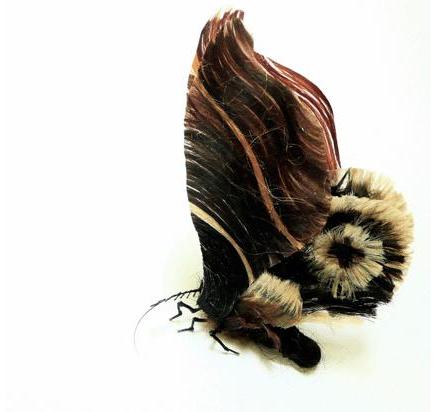
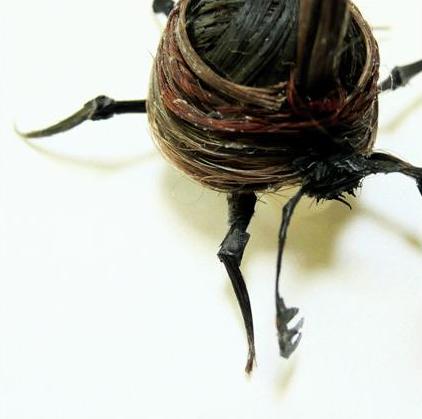
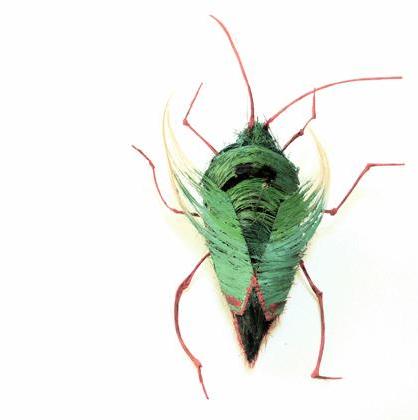
Insects of Hair

“As an artist with a deep interest in sustainable and self-supporting systems, human hair seems the most immediate and true material. I find fascinating the historical implications and various uses of human hair. I am also intrigued with the attraction/repulsion response the material evokes. It is sentimental, challenging and honest.”

butterfly made of glue and human hair by Adrienne Antonson

butterfly made of glue and human hair by Adrienne Antonson

beetle made of glue and human hair by Adrienne Antonson

beetle made of glue and human hair (detail) by Adrienne Antonson

beetle made of glue and human hair (detail) by Adrienne Antonson


beetle made of glue and human hair by Adrienne Antonson

beetle made of glue and human hair by Adrienne Antonson


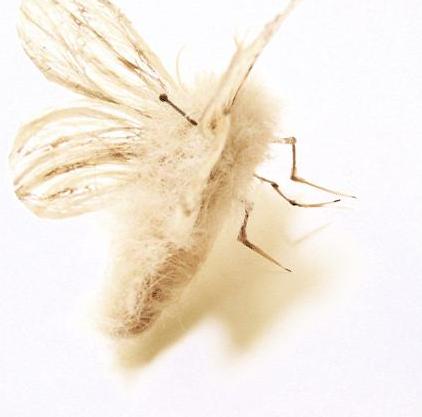
moth made of glue and human hair by Adrienne Antonson

moth made of glue and human hair by Adrienne Antonson

Artist Adrienne Antonson combines three things dear to me: Sculpture, Entomology, and Sustainability. And she does it with one of humanity’s most lasting natural products, human hair. Combining the complicated relationship humans have with both subjects makes for fascinating sculpture. They’re delicate, intimate, and hairy- just like real insects. Sadly the writer of the article I discovered them in has some serious insect-phobias, which is a shame.  At least the artist considers her work beautiful, as do I.


“My current work is inspired by the bizarre behaviors and ingenious evolutionary developments of the insect world. Using materials taken from my own experience and transforming them into real or imagined species provides a unique and intimate perspective on nature and self-sustainability. I see this work as an investigation into my imagination’s relationship with the fluxus state of the natural world.  And it leaves me feeling limitless.” -Antonson

From Souvenir Gallery, Seattle, WA

Adrienne Antonson's show at Souvenir Gallery, Seattle, WA


Posted in art | Tagged , , , , , , | 1 Comment

Monochrome Mashups: Hillier, Ernst and Mad Meg

An Ending by Dan Hillier.

JJ Beetle by Dan Hillier

Beetle by Dan Hillier


Though an accomplished painter and illustrator of original works, Dan Hillier has become well-known for his inventive collages sourced from Dover Pictorial Archives, with a dose of Photoshoppery.  His Lovecraftian combinations of prim ladies and writhing tentacles has even inspired people to permanently emblazon his work on their person.

But I have shown you his work to talk about another artist entirely. Hillier’s antler-headed and octopus-tentacled creations continue a style of “artistic alchemy” that was made famous by Max Ernst and other Surrealists. Before Photoshop and scanned images, collages of this nature were made painstakingly by hand, using illustrations from penny-novels.

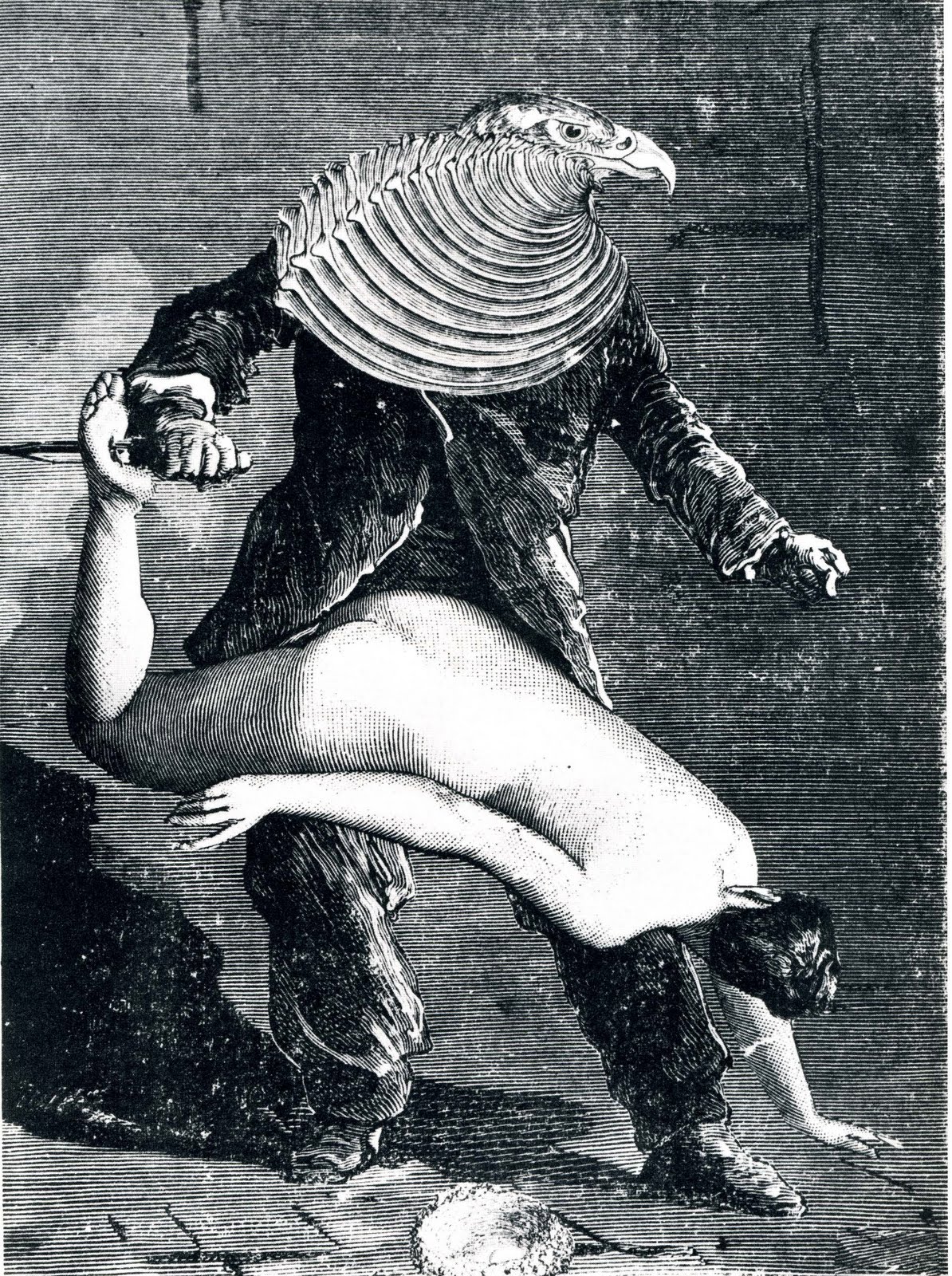
from A week of kindness by Max Ernst

“One day (in 1919), whereas I looked at an illustrated book of objects (umbrellas, watches, tools, clothing, etc) I was surprised to see such different things tight beside the others, things which one does not see together usually, my eyes saw other objects, I wanted to add with the pencil some lines and hatchings between the various objects so that it gives the same images that I see in my dreams.” –Max Ernst.

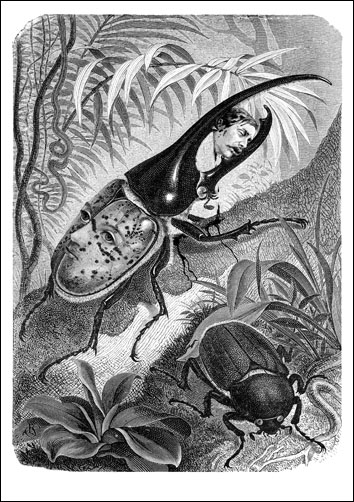
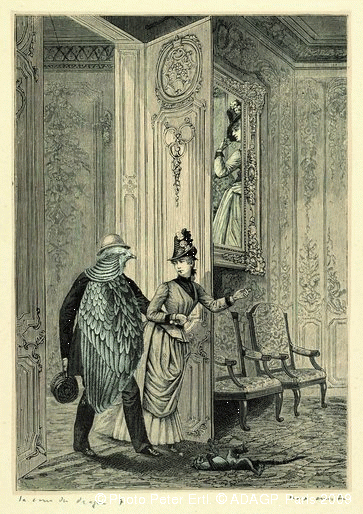
Ernst’s A Week of Kindness (Une semaine de bonté) published in 1934, was filled with prim and proper Victorian lords and ladies doing properly horrible things while sporting the heads of beasts and birds. The bird eventually become his alter ego, (named Loplop), and was to be found throughout his artworks.
ax Ernst

from A week of kindness by Max Ernst
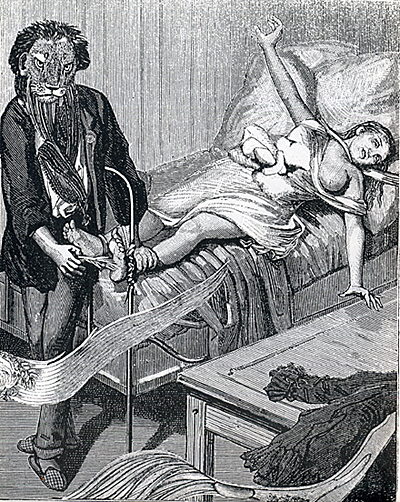
from A week of kindness by Max Ernst

Max Ernst

from A week of kindness by Max Ernst

What makes Max Ernst’s monochromatic collages so enduring and unsettling is their coherence. Not only are all the source-works of a similar style, they are positioned in a way that makes visual and narrative sense. The engravings and etchings are also uniformly from earnest scientific, historical or literary depictions, their seriousness adding to the humor and horror prevalent in each collection. The head positions and scales of the animal-heads match nearly seamlessly, helped by some additional cross-hatching and inkwork. Ernst also deliberately chose banal images, staying away from immediately recognizable works by artists such as Gustave Doré.

Another more narrative art-book series was entitled A little girl dreams of taking the veil (Rêve d’une petite fille qui voulut entrer au Carmel ) Has some bits of entomology throughout:

“who am i? i myself, my sister or this obscure beetle?” (embarrassment.) by Max Ernst

“...Upsy-daisy! Upsy-daisy!...” from A little girl dreams of taking the veil by Max Ernst

But I have shown you his work to talk about another artist entirely. While searching randomly for “insect-headed” artworks, I came upon what appeared to be another photoshop collection, or possibly very clever collages, of men with the heads of insects:
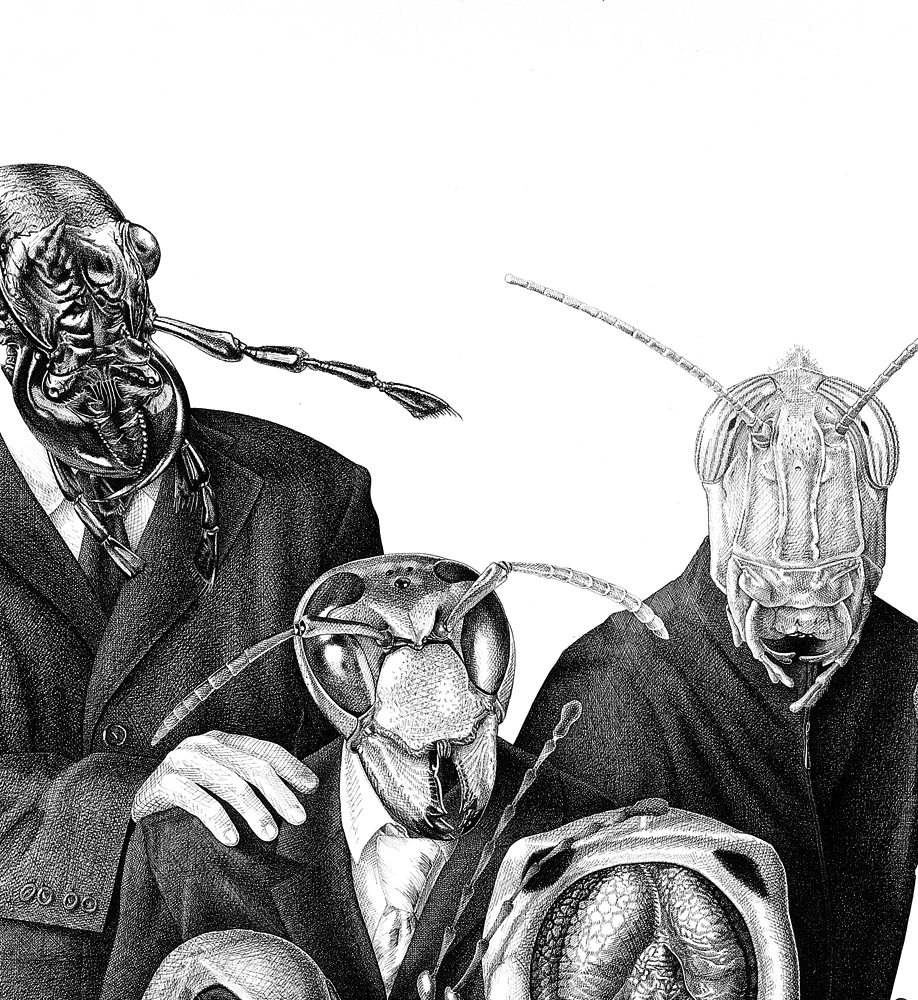
La leçon de pornographie (detail) by Mad Meg

La leçon de pornographie (detail) by Mad Meg

Except it is neither. “Mad Meg” Margot (the art-allusionary alias of a contemporary French artist and illustrator with very little bio information) creates immense hand-drawn tableaux of generic wealthy gentlemen wearing the heads of insects, often using gestures and motifs, and styles found in works of the 15th century masters. Her site is huge, voluminous, and full of elaborate re-inventions of famous Flemish works. It is also full of animals, comics, and insects, glorious insects! Especially striking are the invert-headed gentlemen found throughout:

La leçon de pornographie by Mad Meg

This work in particular is based on Rembrandt’s 1632 work La leçon d’anatomie du docteur Tulp. The line up here is Butterfly, Mantis, Carabid Beetle, Wasp, Weevil, Caterpillar, Locust and Amblypygi (aka tailless whip scorpion).
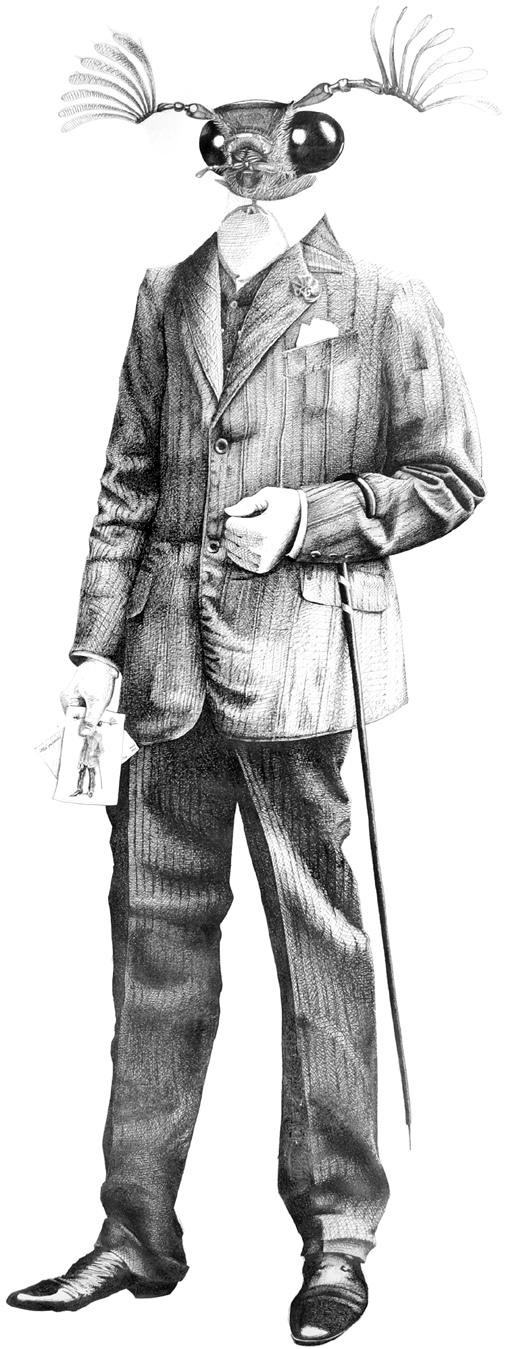
Patriarche No. 32 by Mad Meg

Patriarche No. 32 by Mad Meg

Cockchafer-headed gentlemen from the Patriarches series
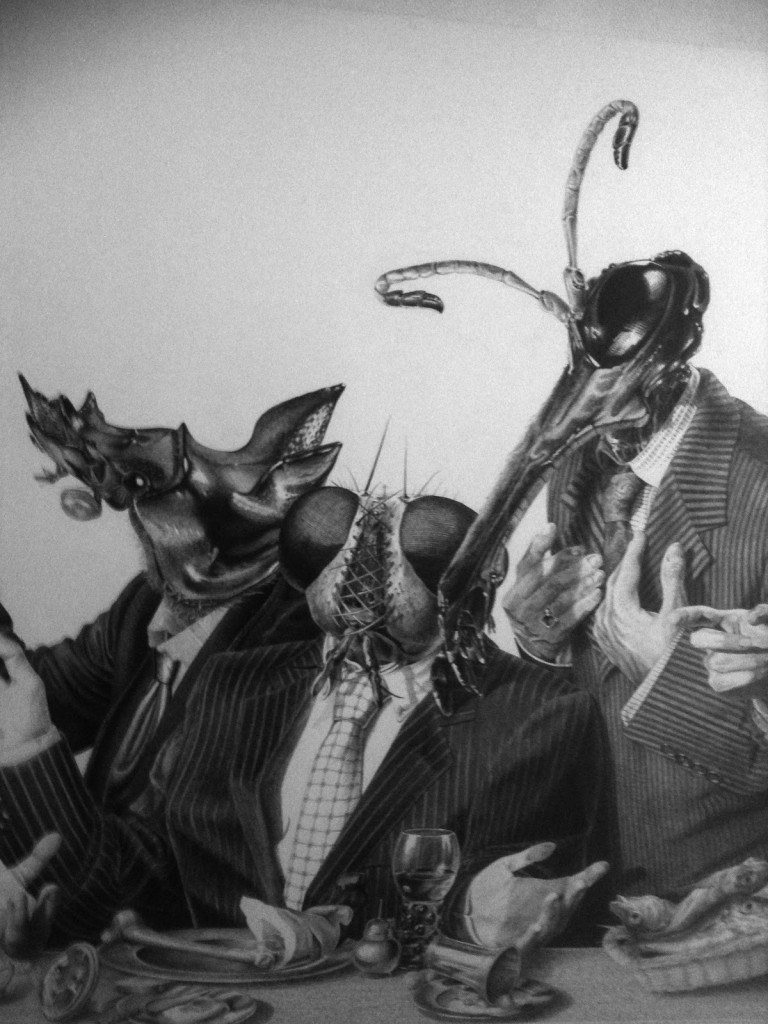
Feast of fools (detail) by Mad Meg

Feast of fools” is a gigantic ongoing work in which the Last Supper (or something very much like it) is not only populated with insect-headed businessmen, but every place setting is based on still-life paintings and photographs from Caravaggio to Joel Peter Witkin.

Instead of pillaging readymade scientific illustrations to create commentary,  Mad Meg’s work is a hand-drawn collage of scientific and fine artworks, their origins merged through her use of a monochrome palette and uniform style.  Miniscule invertebrate heads are placed seamlessly on towering human bodies, giving well-to-do men of the world an otherworldly horror, their base motives laid bare on their countenances. Like Ernst’s lion and vulture-men, some insects have an allegorical context (locusts, wasps and flies for example). However the use of obscure invertebrates always makes me wonder: What does an Amblypygi head signify to the general public? Will greater knowledge of obscure invertebrates create new allegories beyond the simply grotesque?  I’d like to hope someday that would be the case.
 

Posted in art | Tagged , , , , , , , , , , , , , , , | Leave a comment

Viktor Pelevin’s The Life of Insects (Жизнь насекомых)

“Now I do not know whether I was then a man dreaming I was a butterfly, or whether I am now a butterfly, dreaming I am a man.”  -Zhuangzi

Years ago I was thankfully urged to read the novel The Master and Margarita by Mikhail Bulgakov, an epic Russian satiric novel about the Devil and his retinue causing mayhem in the Soviet Union. In it, characters turn into witches, a giant cat drinks, shoots, and leaves, and modern people are shown to be generally greedy and vain and hilariously unprepared for the predations of the Devil and his minions. Recently I have re-read The Life of Insects by contemporary Russian author Viktor Pelevin, who himself was struck by Bulgakov’s ability to thoroughly skewer Russian society by inflicting inexplicable myths onto the totalitarian Soviet world-view, and has incorporated both satire and magic realism into his novel, exposing the insects within us.

Written in 1993 after the collapse of the Soviet Union and the unraveling shifts that followed, The Life of Insects is set around a seedy decaying Crimean resort.  It starts with two rather shady Russian businessmen meeting a third, an American, here to sample the “local business opportunities”.  Then effortlessly they transform into mosquitoes and hunt for fresh blood to try. Or were they already mosquitoes and transformed briefly into bloodsucking opportunistic businessmen?  A brief explanation of the shape-shifting from the author at this point is all the help the reader going to get, and after that, it’s every louse for himself as several protagonists merge fluidly from human to hexapod as the stories themselves weave and fold in on each other with gleeful abandon.  Descriptions, biology, and even scale of the characters and settings vary even in the same sentence. A desperate fly prostitute named Natasha is mistaken for a speck on the American’s dinner plate, but is soon sidling up to him in a dress of shimmering iridescent green,

“The shyly fluttering wings, looking like two sheets of mica glimmering with all the colors of the rainbow, were covered with the standard pattern of dark lines; no special skill in wing reading was required to read her simple fate in them.”

Marianna Markaki, "Life of Insects series", pencil and ink

More than just a satire of Russian society (with plenty of jabs at both communism and capitalism), Pelevin’s novel is partly a series of essays on the connections we feel with insects in our everyday struggles: Mosquitoes are often viewed as lazy contemptible parasites, and Dung beetles are thought to be Sisyphean toilers, blindly pushing their balls of dung before them. A young girl in high heels lands in the resort town filled with promise and romance, and quickly and inexorably finds herself alone and pregnant, trapped in a hovel; she is a young ant, and the narrative of an ant queen’s brief and only flight of freedom, followed by an enforced sedentary life as an egg-producer is one most people can relate to. It is hard not to identify with Seryozha, a cicada larva spending an eternity shoveling through the workaday dirt of his existence, unearthing the same front door, office, and desk each day, hoping to someday emerge into the world above.  Even more than portraying humans as animals, insects have an extra edge of otherness and insignificance attached to them in our psyche, which makes comparisons even more apt.  We are powerless to stop a moth from its determination to fly towards the lamp, and feel deeply for its folly. In Pelevin’s world, the moths tell their story, here represented as two endlessly philosophizing winged compatriots trying to understand the nature of the light they feel driven towards, until at one point he comes to a revelation:

Yulia Medveditskova, "Natasha",

“I’ve just realized, he said, “that we’re really not moths at all. And not..”
“It’s probably not even worth trying to express it in words,” said Dima. “And anyway, nothing around you has changed just because you’ve understood something. The world’s just the same as it was. Moths fly toward the light, flies fly toward shit, and they’re all in total darkness. But now you’ll be different. And you’ll never forget who you really are, right?”
“Of course,” replied Mitya. “There’s just one thing I don’t understand. Have i just turned into a firefly, or was I always one?”

Posted in art, literature | Tagged , , , , , , , , , , | 3 Comments

Beetle on the Brain

My friend Clear alerted me to this lovely skull made entirely of beetle images, by none other than Noah “Skulladay” Scalin, who says of it:

“I made this piece as a proposal for a client, but as it was nearing completion I realized it was a bit too creepy for their needs. Ah well, it was fun to make regardless…”

BugSkull by Noah Scalin

Posted in art | Tagged , , | Leave a comment

Maratus voltans, spider supreme!

I’ve been showing this video all week to everybody in range of my computer. It’s simply the most awesomest salticid display, EVAR. And if you know your jumping spiders, you can bet that it’s no mean feat. Watch the entire video, or just scoot to 3:01. it’s absolutely insane.

oh unk. thanks to bug girl, i see Mr. Otto has an entire flickr site of the fella

Posted in spider | Tagged , , | Leave a comment